
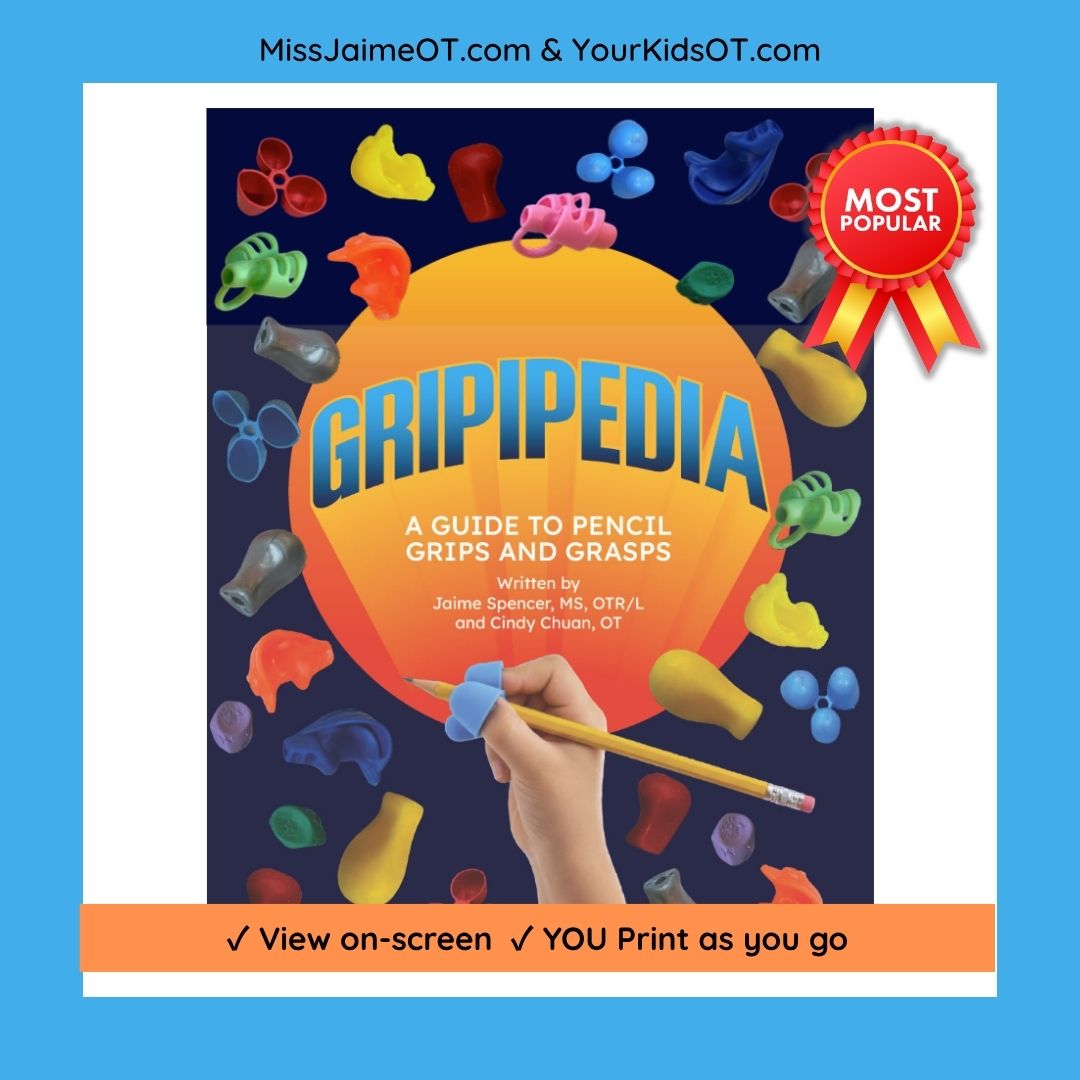
Gripipedia: A Guide to Pencil Grips and Grasps — Digital Edition (PDF)
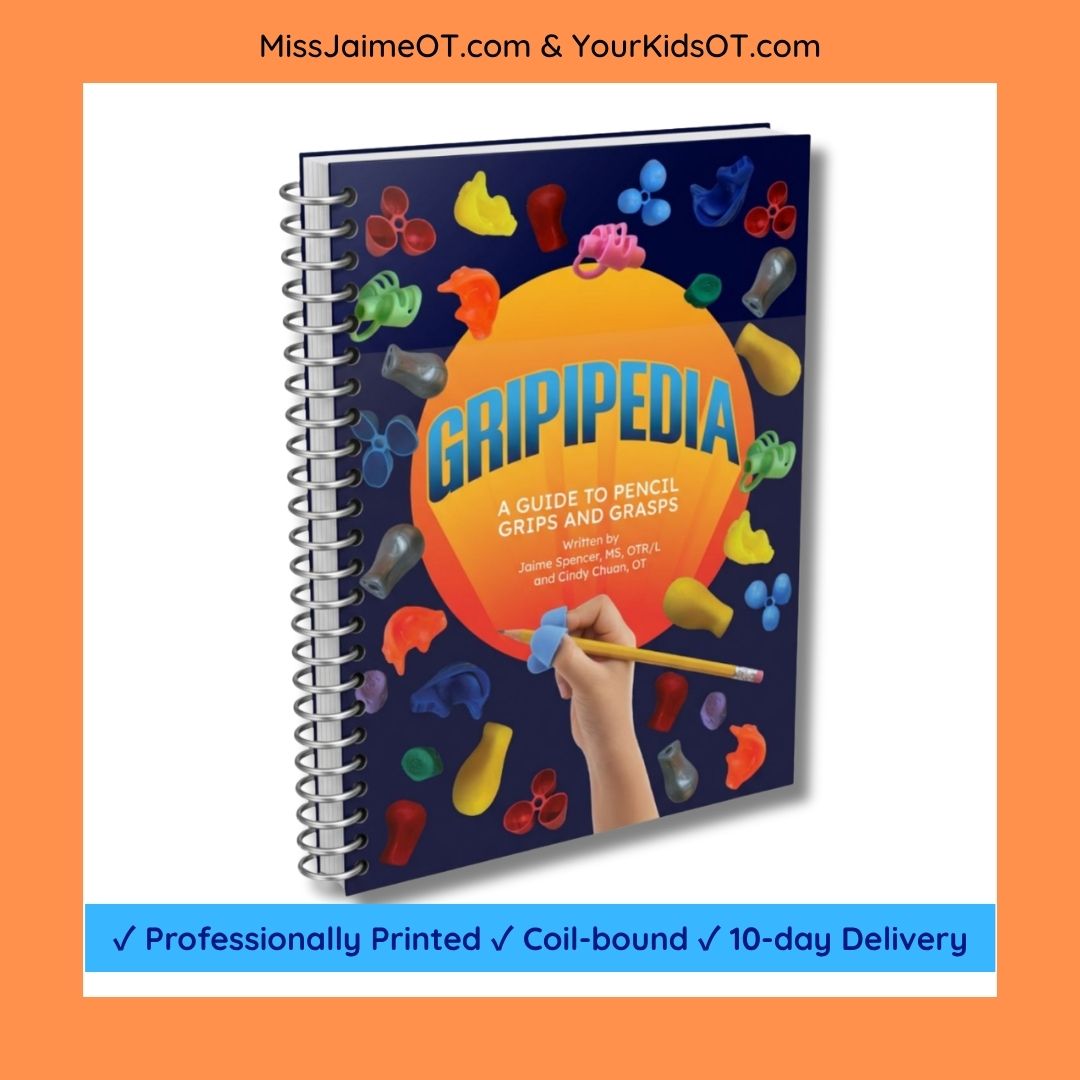
Gripipedia — Print Edition (Coil Bound)
We wrote the Gripipedia because we felt there should be a MUCH easier and faster way to answer the same questions over and over.
We wanted a way to simplify the process of helping children’s fine motor skills.
And most importantly, we wanted a fast and easy way to help teachers and parents carry-over our recommendations.
“What grasp should I teach?” “Should I change this student’s grasp?” “How can I get the parents to carry it over?” “Does their grasp matter if the handwriting is neat?” “My student grips too tightly – how do I get them to hold it correctly?”
For each of these questions, the information existed somewhere. A chapter in Henderson and Pehoski. A paragraph in the Schwellnus 2012 paper. A YouTube video I’d bookmarked three years ago. A handout I’d made for a PD session in 2019 sitting in a folder on my desktop.
But there was no single place where the research and the classroom-ready tools lived together. Therapists had to choose: dig through the literature and build their own materials, or give up on the whole thing altogether. Common sense tells us that something isn’t working, but there are too many barriers to fixing it.
That’s the gap Gripipedia fills.
Where the Idea Actually Started
I’ve been a school-based occupational therapist for over 25 years. In that time I’ve accumulated a perspective on pencil grasp that isn’t particularly complicated but also isn’t captured anywhere in one place: grasp matters because of what it enables, not just what it looks like. A child’s grasp pattern tells you something about their underlying hand development. And the tools you use to change it — or support it, or teach around it — need to match both the child and the evidence.
The problem I kept running into was that the professional literature on grasp is scattered across decades of research in at least three different journals, several textbooks, and a body of wisdom that lives mostly in the heads of experienced OT practitioners who trained under people like Mary Benbow. Meanwhile, the classroom materials were lacking. A few posters, and songs lived on Teachers Pay Teachers or in individual OTPs’ filing cabinets, disconnected from the research entirely.
I’d been thinking about this gap for years. I’d been drafting pieces of something — a handout here, a reference chart there — without a clear sense of what the whole thing should be.
I just knew that promoting good fine motor skills and proper pencil grasp patterns shouldn’t be this hard.
I was chipping away at this book, but life kept getting in the way. Then I met Cindy. Cindy and I met years ago when we were writing “The Handwriting Book, The Scissors Skills Book, and The Toileting Book” with a bunch of other OT and PT Bloggers. We just clicked. I kept telling her about the newest barrier stopping me from finishing the Gripipedia (moving, getting married, getting cancer, dealing with grief from the death of family members). Finally, I said, “Want to work on it with me?”
What Cindy Brought to This
Cindy Chuan is an occupational therapist based in Australia with deep expertise in fine motor development and handwriting. You may know her from Your Kids OT. When we started talking — about grasp, about evidence, about what practitioners actually need in their hands when they’re sitting across from a kindergartner who’s wrapping their thumb around a pencil — I realized that what I’d been building in pieces was more complete in collaboration.
Cindy brought a different context, a different training background, and a perspective on the resource-pages half of the book that shaped what it became. The tools in Gripipedia aren’t generic. They’re built around specific situations, informed by decades of combined practice experience, and grounded in research we both know well enough to teach.
Co-authoring a resource is slow. It involves a lot of conversations that start with “but what does the research actually say” and end with “okay, but here’s what I see in practice.” Gripipedia is the product of those conversations. I think it’s better for them.
What’s Actually in the Book
Gripipedia is 150 pages, and it’s organized in two halves.
The first half is a reference. It covers what the research says about pencil grasp — not the simplified version, but the actual nuanced picture, including what the studies excluded and what “grasp doesn’t affect legibility” actually means and doesn’t mean. It covers grasp development from early immature patterns through mature functional grasps, the anatomy of the hand and why it matters, joint laxity and adaptive grasps, the fine motor prerequisites for a functional grasp, evaluation, decision-making, and intervention across the developmental range.
This is the part of the book I wish had existed when I was a new school OT. It’s also the part I still consult when I’m writing posts and want to make sure I’m citing the right evidence for what I’m describing.
The second half is resource pages. Photocopy-able. Designed for repeated use. Visual cue posters for righty and lefty writers. A developmental progression chart for the right hand and the left hand. Grip evaluation forms. Reward charts with visuals of how to use the grip. Classroom record sheets. A page for every commercially available pencil grip we recommend, explaining when and why to try it and what to tell the teacher and family. Warm-up routines. Positioning guides.
These are the tools we’ve been making individually for 25 years, cleaned up, research-grounded, and put in one place so you don’t have to make them yourself.
What I Want You to Do With It
The reference half is for you to read, refer to, and cite. The resource pages are for you to photocopy without guilt and put in teachers’ hands.
When a kindergarten teacher asks you why you’re recommending a smaller pencil, hand her the page from Gripipedia that explains it, with the citations at the bottom, and let her read it herself. When a parent wants to know if their child’s grasp is a problem, email the developmental progression chart and show them where their child is and where they’re headed. When you’re writing a Tier 1 classroom plan and you need a visual prompt that’s actually grounded in how children learn motor skills, you have one.
That’s what the book is for. Not a shelf reference. A working tool.
When You Can Get It
Gripipedia will be available in digital and print (spiral-coil, lay-flat) formats. The physical format was a deliberate choice — if you’re going to photocopy resource pages repeatedly, the book needs to lie flat on the copier glass. That matters.
Gripipedia: A Guide to Pencil Grips and Grasps — Digital Edition (PDF)
Gripipedia — Print Edition (Coil Bound)

Jaime Spencer
Miss Jaime, OT (Jaime Spencer, MS, MEd, OTR/L) is a school-based occupational therapist and District OT for Levittown School District on Long Island, New York. She is the owner of Miss Jaime O.T., an AOTA-approved continuing education provider, co-author of Gripipedia*, published researcher, member of the NYSED Occupational Therapy Board, fierce advocate for school-based OTPs across the country, and founder of USA School-Based OT’s Looking for Change.*