
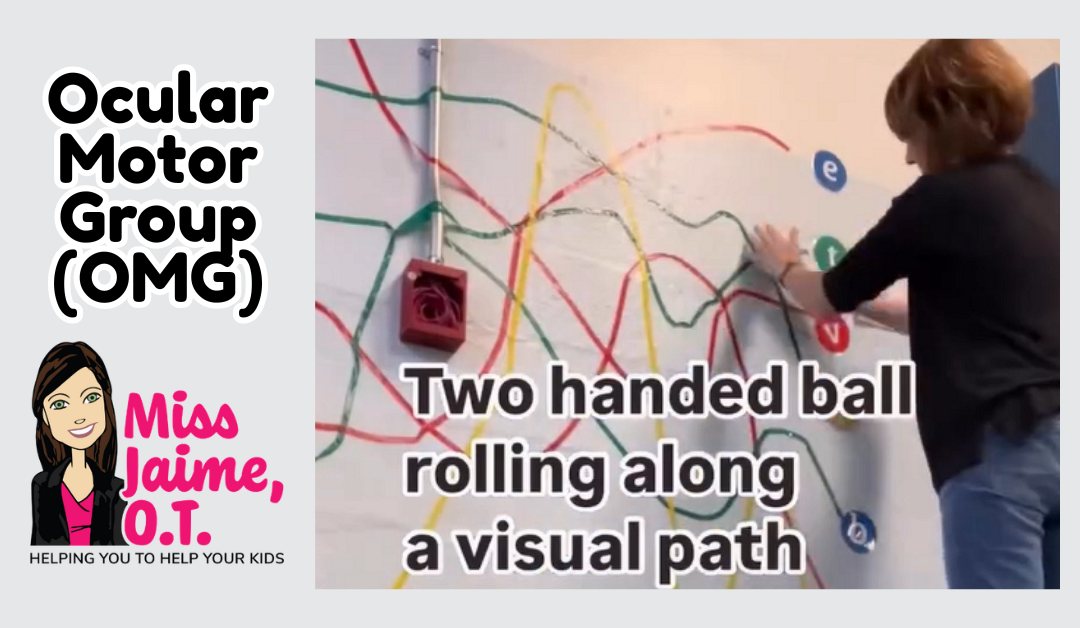
I’ll be honest: I was a little nervous to share these results. Not because they were bad — but because they were really good, and I didn’t want anyone to think I was overclaiming.
But the final data from our new ocular motor group proved just how impactful this work can be. Even the principal said it herself: these numbers are impressive. So here we go.
A Little Backstory
If you’ve been following me for a while, you know I teach a vision course with Robert Constantine for school OTPs. Vision is one of those areas I get genuinely fired up about — because undiagnosed vision issues are constantly getting misread as ADHD, dyslexia, behavior problems, or just a kid who doesn’t care.
Last fall, one of the principals in my district heard I wanted to start an Ocular Motor Group as a multi-tiered support for kids struggling with reading. We got the green light from Special Ed. And then things moved fast.
I had a few days to create the program outline and design all the activities. We ran two groups of four students, seen every other day, rotating through stations every two weeks. Total of about 12 weeks of services (not counting winter break).
I called it the O.M.G. — Ocular Motor Group. You’re welcome.
Here are a couple of videos so that you can get a glimpse of the types of activities I used.
The Results
Students just finished their winter diagnostic testing. Here’s what the data showed — the percentages represent each student’s growth toward their expected benchmark from fall to winter.
► See table on right.
| Student | Reading | Math |
|---|---|---|
| 1 | 183% | 0% |
| 2 | 157% | 87% |
| 3 | 187% | 70% |
| 4 | 43% | 39% |
| 5 | 46% | 30% |
| 6 | 100% | 65% |
| 7 | 0% | 117% |
| 8 | 65% | 0% |
To be clear on what those numbers mean: I asked the school psychologist to walk me through the data because I’d never looked at diagnostic reading or math scores like this before. A score of 183% means that student hit her winter i-Ready goal and then surpassed it by 83%. It’s not just passing — it’s blowing past the expected target.
Here’s the summary:
- 3 students went up 1 grade level in reading
- 1 student went up 2 grade levels in reading
- 3 students went up 1 grade level in math
- 1 student went up 2 grade levels in math
Now — I want to be transparent. I can’t attribute all of this progress to the O.M.G. alone. These kids also had teachers, other support staff, and a lot of other variables in their lives. But I also know what I saw in those sessions. These kids were engaged, they were building skills, and something was working.
What Were We Actually Doing?
The number one question I’ve gotten: What activities did you use?
I pulled from everything I know — ocular motor exercises, brain gym, rhythmic movement, and reflex integration — and built it into playful, engaging stations. Nothing felt like “therapy” to the kids. It felt like games.
That’s intentional. When kids are having fun, you get buy-in. When you get buy-in, you get effort. When you get effort, you get results.
Keep it FUN. That’s not a throwaway tip — it’s the whole strategy.
If you want to learn more about vision and how it connects to learning, behavior, and OT practice, check out the Eyes First course I teach with Robert Constantine. The link is below.
And if you’re thinking about starting something like this in your own district — you absolutely can. You don’t need a perfect program. You need a good reason, a willing administrator, and a solid foundation of knowledge to back up your clinical decisions.
Start there.
Want to learn more about vision and school-based OT? Check out Eyes First → Eyes First Vision
You mentioned in the Inclusive Classrooms Summit 2025 about writing a book about what you did for your Ocular Motor Group. I was wondering if you wrote it. I would love to purchase it! I have taken your vision course and loved it. I think this is great!