
Core strength affects everything from posture to balance to focus. As school-based occupational therapists, we see the impact of weak core strength daily in our students’ difficulties with handwriting, sitting upright during class, and participating in physical education.
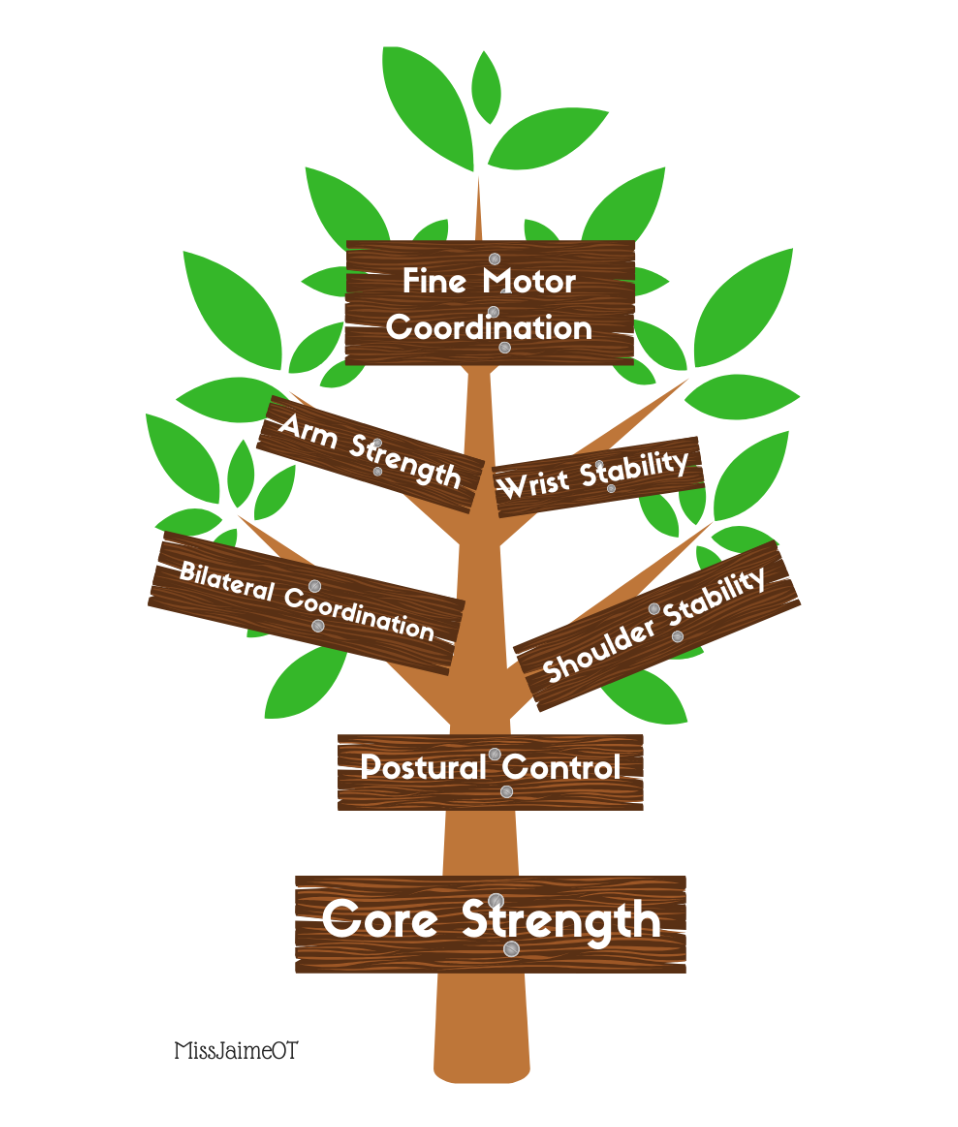
Think of core strength as the trunk of a tree – it’s the foundation that supports all the branches. When students have a strong core, they develop:
- Postural Control – the base of the tree
- Shoulder Stability – supporting fine motor coordination
- Bilateral Coordination – working together effectively
- Arm Strength – for functional tasks
- Wrist Stability – for precise movements
- Fine Motor Coordination – the end result we’re working toward
What We’re Actually Seeing in Schools
After working with hundreds of students, I can tell you that core strength issues show up everywhere. But here’s the thing: they don’t always look dramatic. Nobody’s calling an emergency meeting because a student leans against the wall during line-up. But that same student is struggling to complete written work, can’t maintain attention during circle time, and avoids gross motor activities whenever possible.
The connection between core strength and academic performance is real. When a student is using all their energy just to stay upright in their chair, they don’t have much left over for the actual learning task. The compensations show up in ways we might not immediately recognize as core strength issues.
Red Flags to Look For
Here’s what weak core strength actually looks like in the classroom:
- Struggles to sit upright without support from furniture
- Has trouble sitting independently on the floor
- Finds it challenging to move from sitting to standing
- Cannot comfortably remain seated for expected durations
- Avoids or dislikes physical activities and sports
- Tends to lean against walls when standing in line
- Rests against the desk or table while writing, reading, or listening
- Props head up with a hand when seated at a desk
- Often slumps in sitting or standing positions
- Sits on the floor with legs in a W-shape
- Shows limited endurance during physical tasks
- Struggles with balance-related activities like jumping or hopping
- Has difficulty with fine motor skills (writing, cutting, self-care)
- Finds it hard to sit on the rug, backless seats, or chairs
- Tends to sit with their back to the wall, against the bookcase, etc.
If you’re checking off multiple items on this list for several students on your caseload, you’re seeing what most school-based OTs see. Core strength deficits are common, and they impact everything.
Why This Affects Academic Performance
Good posture and underlying strength are fundamental for sustained attention, legible handwriting, and academic success. Many students need support developing these foundational skills. A strong core provides the crucial foundation for children’s development. These central muscles enable proper posture during seated activities and create the stability necessary for developing fine motor skills and other physical abilities.
When students lack core strength, we see compensatory patterns. They might write only a few sentences before fatiguing. They have trouble maintaining upright posture during instruction. They struggle with tasks that require sustained attention because their bodies are working so hard just to stay positioned correctly.
Setting Up Classroom Seating for Success
Before we jump into strengthening activities, let’s talk about proper positioning. This is basic, but it matters. Ensure proper chair and desk height with feet flat on floor, hips and knees at 90 degrees, and desk at elbow height. Use footrests or cushions when furniture doesn’t fit the student. Consider alternative seating like stability balls, wobble cushions, or standing desks for students who benefit from movement.
Movement breaks are essential. Incorporate stretching, wall push-ups, or carrying heavy items every 15-20 minutes to reset posture and re-energize muscles. This isn’t a behavioral reward. It’s a physiological need. Building strength takes time, so provide frequent breaks and movement opportunities rather than expecting prolonged static positioning.
Core Strengthening Activities That Fit Into the School Day
You don’t need special equipment or dedicated therapy time to build core strength. Most of this can happen during natural school routines. Here’s what works:
In the Classroom:
- Laying on tummy (supported on elbows) to play, read, or color
- Crawling through a tunnel, under a blanket, etc.
- Weight-bearing into the hands and shoulders (yoga or animal walks)
- Pushing and pulling activities
- Pulling a heavy basket across the room
- Pulling a friend on a blanket
- Lifting something heavy
- Rolling down a hill or rolling across the room
- Picking up toys or clothes from the floor
- Being on all fours to play a game
- Tumbling and doing somersaults
- Sitting on exercise balls during activities
- Practice “criss-cross applesauce” sitting on the floor to build core endurance
Strengthen Core Muscles Through Fun Activities:
Crawling games, wheelbarrow walks, planks disguised as “bridges,” or sitting on exercise balls during activities all work. Practice “criss-cross applesauce” sitting on the floor to build core endurance. These activities don’t look like therapy, which makes them easier to implement in classroom settings.
During Recess and PE:
- Climbing up a slide
- Riding a bike or a scooter
- Climbing activities (playground structures, indoor climbing walls)
- Using playground equipment
- Going on the monkey bars
- Climbing up ladders
- After-school sports: swimming, yoga, karate, dance, basketball, soccer
Heavy Work Throughout the Day:
Activities such as karate, gymnastics, dance, swimming, wrestling, horseback riding, and yoga are great for building core strength. These aren’t just extracurriculars. They’re functional interventions. When writing recommendations for families, suggest community activities that naturally build strength.
Classroom Jobs and Chores:
This is where you can be really strategic. After-school chores work too: raking leaves, washing the car, shoveling snow, sweeping floors. Chores that require arms up like wiping windows, painting, or folding laundry build upper body strength. Household tasks like carrying groceries, folding laundry, washing the car, and organizing shelves can improve upper body strength.
In the classroom: carrying supplies to other rooms, pushing chairs back under tables, organizing heavy books on shelves, washing desks, sweeping, watering plants with a full watering can.
Upper Body and Arm Strength Connections
Core strength and upper body strength work together. You really can’t develop one without the other. Building upper body and arm strength is essential for children’s fine motor development, handwriting skills, and overall physical confidence.
Activities That Work:
- Swimming (dive into it as an enjoyable exercise that effectively builds overall strength and endurance)
- Climbing activities (encourage climbing on playground structures or indoor climbing walls to build upper body strength and coordination)
- Monkey bars (visit a playground with monkey bars and encourage your child to traverse them to improve grip strength and upper body muscle tone)
- Use resistance bands (incorporate resistance band exercises into your routine to provide variable resistance for arm and upper body workouts)
- Balloon volleyball (the goal is to keep the balloon off the ground using hands, which enhances hand-eye coordination and arm movement)
- Play catch (regular sessions of playing catch with a ball or beanbag can improve hand-eye coordination and arm strength)
- Play tug-of-war (engage in friendly tug-of-war games, as this activity promotes upper body strength and teamwork)
- Gardening (activities such as digging, planting, and watering plants engage the upper body and promote motor skills)
Building Shoulder Stability
Shoulder stability is often the missing link when we’re working on handwriting difficulties. Heavy work activities build shoulder strength: carrying books, pushing/pulling chairs, wall push-ups, or resistive crafts like hole-punching. Drawing on vertical surfaces (easels or whiteboards) naturally engages shoulder muscles.
Integrating Postural Control Strategies
Encourage students to sit up tall by imagining strings pulling from their heads. Use “posture checks” throughout lessons. Remember that building strength takes time. The goal isn’t perfection. It’s progress.
Work at a low table in kneeling. Try squatting games and activities. Use playground equipment. Go on the monkey bars. Climb up ladders. These activities all build the postural control students need for classroom success.
Collaborating with Classroom Teachers
When you consult with teachers, focus on the connection between posture and performance. Share specific accommodations: adjusted furniture, alternative seating, scheduled movement breaks. Frame it as supporting attention and handwriting, not just physical development. Teachers respond well when they understand the academic connection.
Explain that movement breaks aren’t rewards for good behavior. They’re necessary resets that help students maintain upright posture and attention. Most teachers will gladly incorporate these strategies once they see the impact on student performance.
Making It Work Long-Term
Here’s what I know from experience: occasional therapy sessions won’t build core strength. Students need consistent practice throughout the day. The good news is that most strengthening activities can happen naturally during classroom routines, recess, and daily tasks.
Core strength work doesn’t have to be complicated. It needs to be consistent. Look for natural opportunities throughout the school day. Make activities functional and purposeful. Build it into routines so it’s not an extra thing but just part of how the day flows.
Start with one or two strategies. Build from there. When you see a student who previously couldn’t maintain upright posture now sitting independently through a 10-minute lesson, you’ll know the work is paying off. That’s what we’re working toward.
Where can I find the QR code cards?
Answered Jo directedly via Desk email on 1/7/2026:
From
“Miss Jaime O.T.”
To
amityot@outlook.com
Cc
support@missjaimeot.zohodesk.com
Hi, Jo! It’s Kim from the Miss Jaime, O.T. team!
I saw your question about the QR codes you were looking for on the Core Strength blog post.
Turns out, this was a post that was shared on behalf of Inspired Treehouse’s product. (And it’s an issue we didn’t find when we migrated our website a while back.)
So, here is the link to their $15.99 product: https://shop.theinspiredtreehouse.com/product/the-core-strengthening-activities-program/
I hope that helps, and we’re going to get that issue fixed soon (this month)!
If you ever have a question or need anything else, feel free to hit us up at Info@MissJaimeOT.com. We’re here to help!
Take care,
Kim
Proud Member of Miss Jaime’s Small, but MIGHTY, Team!
Customer Service @ MISS JAIME, O.T. • e: CustomerService@MissJaimeOT.com
http://www.MissJaimeOT.com (Watch the spelling of Jaime!)