
A frustrated mom showed me her Pinterest board titled “Fine Motor Activities” – it had 847 pins. She looked exhausted just scrolling through it. “I’ve tried so many of these, but I honestly can’t tell if they’re helping or if I’m just keeping him busy,” she said.
I completely understood her overwhelm. The internet is absolutely flooded with fine motor activity suggestions, but most don’t tell you the crucial information: WHY the activity works, WHICH children benefit most, and HOW to know if it’s actually making a difference.
After 20+ years of clinical practice and countless hours analyzing what truly moves the needle for children’s fine motor development, I’ve identified the activities that consistently produce measurable results. Today, I’m sharing my go-to activities.
The Overwhelm Is Real
The truth is, parents are drowning in options. I see families trying dozens of different activities every week – play dough on Monday, threading beads Tuesday, cutting activities Wednesday – and feeling exhausted by the sheer volume of “shoulds.” But here’s what I’ve learned after years of watching what actually works: fine motor development doesn’t have to be complicated. In fact, the most effective approach uses just a few targeted activities done consistently rather than constantly switching between endless Pinterest projects.
Foundational Fine Motor Skills
In Case-Smith’s occupational therapy for children and adolescents, Schneck and O’Brien (2020) suggest that in hand manipulation activities may be appropriate in children with handwriting deficits.
The magic happens when activities target multiple systems simultaneously: proprioceptive input builds awareness, resistance creates strength, and precision tasks develop control.
Suggestion
You may start with proprioceptive input to “wake up” the hand muscles, progress to strength-building activities, then finish with precision tasks that require the skills you just activated.
A Warm-Up Exercise
Sometimes, the warm-up alone produces more progress than an entire Pinterest craft session!
🎥 Warm-Up Videos
Use these guided handwriting warm-up videos that walk children through engaging demonstrations. These are designed to prepare hands for fine motor success.
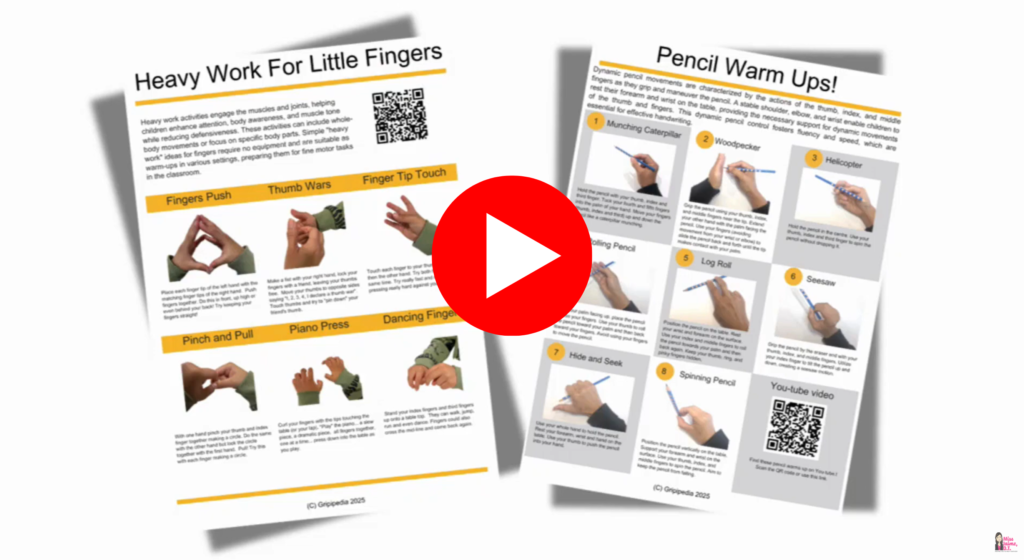
Category 1: Heavy Work for Hand Awakening
Ages 3-8
Therapy Putty
Why It Works: Therapy putty provides resistance that builds intrinsic hand strength while providing proprioceptive feedback. Unlike Play-Doh, therapy putty maintains consistent resistance properties and requires sustained muscle activation.
Putty activities may target the thumb opposition and finger isolation patterns needed for mature pencil grasps.
Developmental Modifications:
- Ages 3-4: Softer putty, larger hidden objects, 5 repetitions
- Ages 5-6: Medium resistance, smaller objects, 8 repetitions
- Ages 7+: Firmer putty, tiny objects like beads, 10+ repetitions
Wall Push-Ups and Weight Bearing
Use these exercises to improve wrist stability and shoulder strength
Why It Works: Weight bearing through the hands provides proprioceptive input while building the shoulder and wrist stability that underlies all fine motor control. This isn’t just about hand strength – it’s about creating the stable platform hands need to work.
Progression Sequence:
- Level 1: Hands flat against wall, 30 seconds
- Level 2: Fingertips only against wall, 20 seconds
- Level 3: Crab walk position, 15 seconds
- Level 4: Bear walk across room
Category 2: Pattern Building
Ages 4-8
In-Hand Manipulation Coin Rotations
Why It Works: In-hand manipulation is the secret sauce of fine motor development. Children who can rotate objects within their palm are able to complete fine motor activities more easily.
Reasoning: In-hand manipulation is needed for pencil adjustment during writing, eraser flipping, and the subtle finger movements needed for efficient letter formation.
Reasoning
In-hand manipulation is needed for pencil adjustment during writing, eraser flipping, and the subtle finger movements needed for efficient letter formation.
Troubleshooting Tips:
- If too difficult: Start with larger, textured objects
- If too easy: Add time pressure or dual tasks
- For motivation: Use special tokens or “treasure coins”
Precision Pincer Progressions
Foundational for all functional fine motor skills
Why It Works: The pincer grasp (thumb and index finger working together) is one of the first fine motor skills that children develop. True pincer development follows predictable patterns when appropriately challenged.
Pincer Grasp Tips:
- Objects must be small enough to require fingertip contact
- Container opening must prevent whole-hand dropping
- Activity must require sustained pincer hold
- Visual component should encourage precision placement
My Go-To Setup
Tweezers with pompoms and ice cube trays. Takes 30 seconds to set up, provides 5 minutes of focused practice, and builds the exact muscle patterns needed for pencil control. No Pinterest-worthy presentation required!
Measuring Real Progress
I absolutely want children to enjoy their fine motor activities – engagement is crucial for learning! But I also want parents to feel confident that the time they’re investing is actually building the skills their child needs. The beautiful thing is, when activities are appropriately challenging and produce real results, children naturally feel more confident and engaged. Here’s how I help families track meaningful progress:
Functional Benchmarks:
- Endurance: Can they sustain fine motor activities longer than before?
- Pressure: Are they using appropriate force without fatigue or pain?
- Speed: Can they complete familiar tasks more efficiently?
- Precision: Are their movements becoming more accurate and controlled?
- Transfer: Are you seeing improvement in functional tasks like dressing and eating?
One of my favorite progress moments happened with a 6-year-old who’d been doing in-hand manipulation exercises for three weeks. His mom called me, excited: “He buttoned his entire shirt this morning without help, and last night he opened his own yogurt container!” That’s functional transfer – when intervention activities improve real-life skills.
🌟 Ready to See These Results at Home?
These handwriting warm-up videos guide children through a proactive sequence with engaging demonstrations, perfect timing, and built-in motivation. Just press play!
Each video is designed to seamlessly fit into your daily routine while building the specific skills your child needs for handwriting success.
Want More Fine Motor Support? 📚
These activities are just the beginning of what effective fine motor intervention looks like. Understanding WHY activities work, HOW to progress them systematically, and WHEN to modify for different children requires comprehensive knowledge of motor development and intervention science.
My upcoming book, Gripipedia, includes a resource collection with detailed visuals for the classroom, progression charts, and troubleshooting guides that transform random activity suggestions into systematic intervention programs.
Ready to take the next step? Join my email list (form below) for early access to these comprehensive intervention resources!
References
Case-Smith, J. (1996). Fine motor outcomes in preschool children who receive occupational therapy services. American Journal of Occupational Therapy, 50(1), 52-61.
Case-Smith, J., & O’Brien, J. C. (2015). Occupational therapy for children and adolescents (7th ed.). Elsevier Health Sciences.
Cornhill, H., & Case-Smith, J. (1996). Factors that relate to good and poor handwriting. American Journal of Occupational Therapy, 50(9), 732-739.
Dankert, H. L., Davies, P. L., & Gavin, W. J. (2003). Occupational therapy effects on visual-motor skills in preschool children. American Journal of Occupational Therapy, 57(5), 542-549.
Exner, C. E. (2001). Development of hand skills. In J. Case-Smith (Ed.), Occupational therapy for children (4th ed., pp. 289-328). Mosby.
Pehoski, C., Henderson, A., & Tickle-Degnen, L. (1997). In-hand manipulation in young children: Translation Movements. American Journal of Occupational Therapy, 51(9), 719-728.
Schneck, C. M., & Peganoff-O’Brien, S. (2020). Assessment and treatment of education performance. In J. C. O’Brien & H. Kuhaneck (Eds.), Case-Smith’s occupational therapy for children and adolescents (8th ed., pp. 384–410). Elsevier.

Jaime Spencer
Miss Jaime, OT (Jaime Spencer, MS, MEd, OTR/L) is a school-based occupational therapist and District OT for Levittown School District on Long Island, New York. She is the owner of Miss Jaime OT, an AOTA-approved continuing education provider, and co-author of Gripipedia*, the definitive clinical reference and classroom resource guide for pencil grasp.*