
A Visual Guide to Pencil Grip Development That Actually Makes Sense
Last week, a kindergarten teacher showed me her classroom pencil grasp poster and asked, “Why doesn’t this match what I’m seeing with my kids?” She pointed to five different children, each holding their pencils in completely different ways, and honestly looked a bit defeated.
This happens all the time because most developmental charts show you the end goal without explaining the amazing journey children take to get there. Today, I’m sharing the visual progression I use every single day in my practice – one that shows you what normal development actually looks like, not just what we hope it becomes.
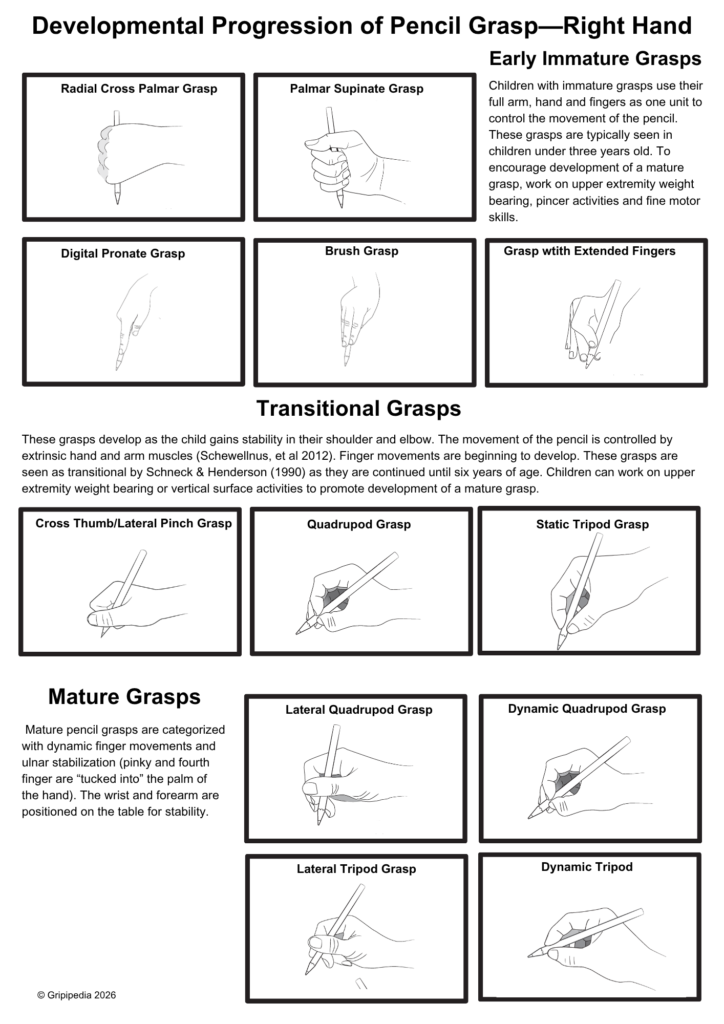
Developmental Progression of Pencil Grasp—Right Hand Early Immature → Transitional → Mature Grasps © Gripipedia 2026
Stage 1: Early Immature Grasps (Under 3 Years)
The “Whole Body Writer” Phase
Children with immature grasps use their full arm, hand, and fingers as one unit to control the movement of the pencil. These grasps are typically seen in children under three years old, but don’t panic if you see them in slightly older kids who haven’t had much crayon or pencil exposure!
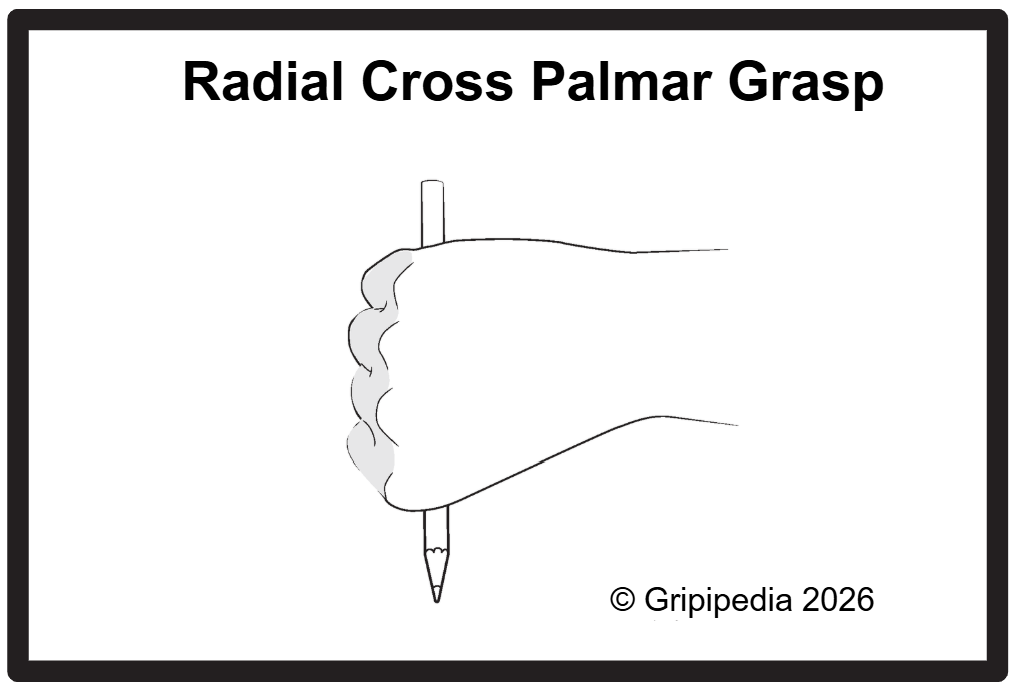
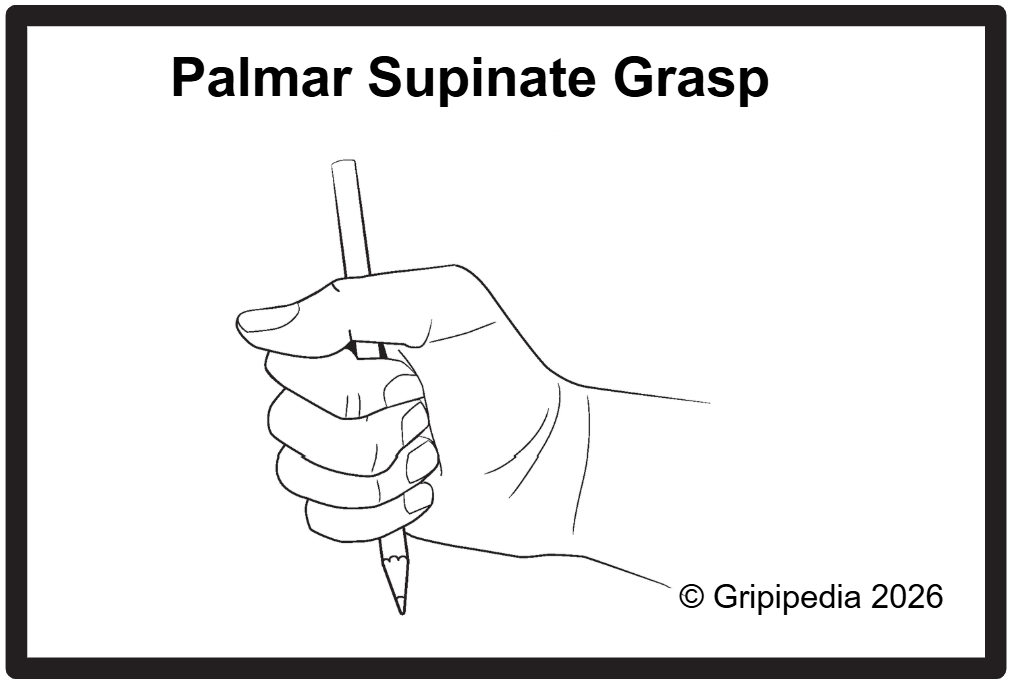
Radial Cross Palmar Grasp & Palmar Supinate Grasp
These are your classic “fisted” grasps. I watch toddlers use these patterns and they’re absolutely perfect for this stage! The radial cross palmar has the thumb wrapping around to meet the fingers, while the palmar supinate looks like they’re holding a hammer with the thumb pointing up. Both give children the stability they need when their small finger muscles aren’t ready for precise control yet.
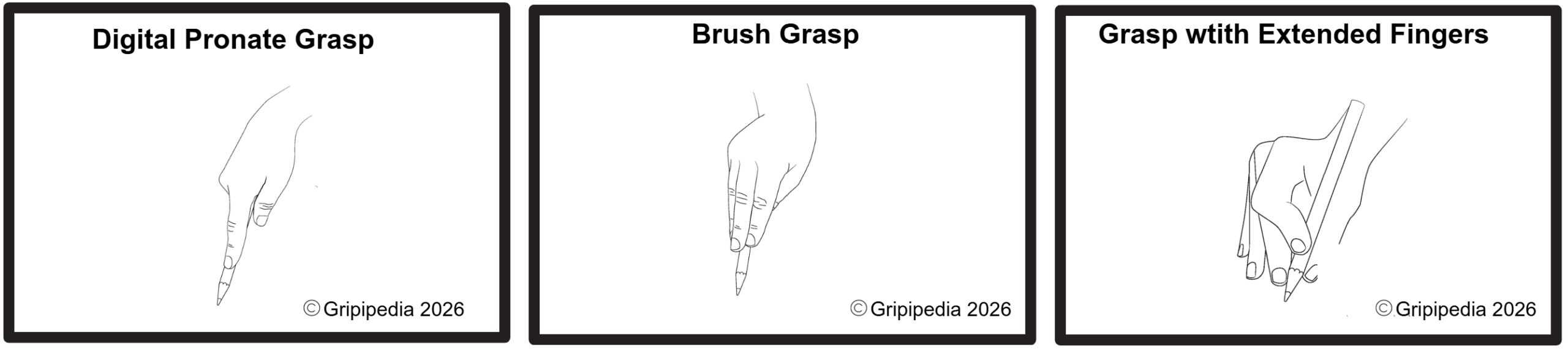
Digital Pronate, Brush Grasp & Grasp with Extended Fingers
These patterns show children starting to use their fingertips more, but still with that whole-arm control. The digital pronate has the wrist turned down, the brush grasp looks exactly like holding a paintbrush, and the extended fingers pattern shows all fingers involved but not quite flexed properly. I love seeing these because they tell me a child is experimenting and building strength!
I watched my friend’s 2-year-old create an entire rainbow using a brush grasp, switching to a palmar supinate when she needed more pressure for darker colors. She was unconsciously choosing the right tool for the job – that’s developmental brilliance in action! 🌟
How to Support This Stage
Upper extremity weight bearing is your best friend here. Crawling, bear walks, pushing toys, climbing playground equipment – anything that builds shoulder and arm strength. Pincer activities with cheerios and small toys develop finger dexterity. Most importantly, provide lots of chunky crayons and markers without worrying about “correcting” their grasp.
Stage 2: Transitional Grasps (Ages 3-6)
Where Development Gets Interesting
These grasps develop as the child gains stability in their shoulder and elbow. The movement of the pencil is controlled by extrinsic hand and arm muscles, and finger movements are beginning to develop. Schneck & Henderson (1990) identified these as transitional because they continue until six years of age – and that timeline is completely normal!
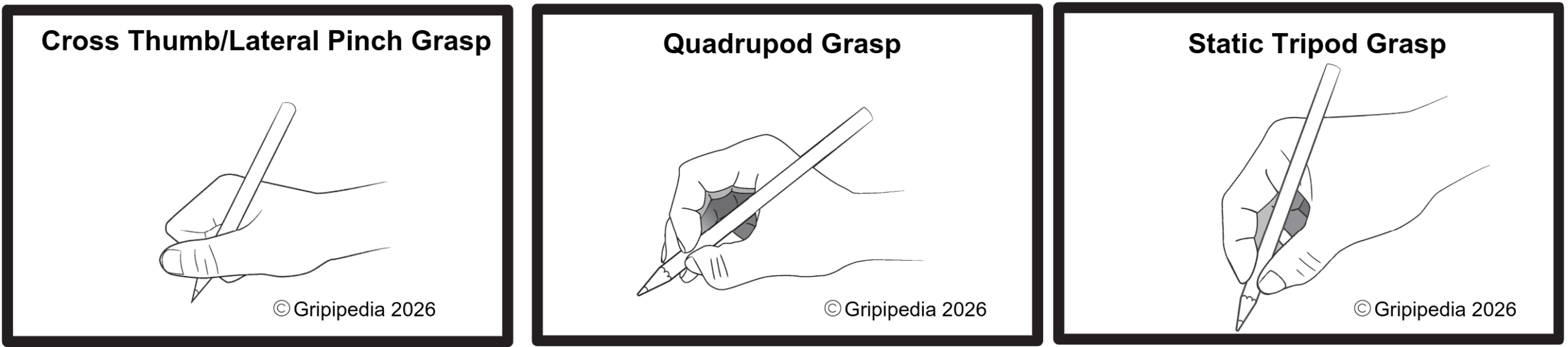
Cross Thumb/Lateral Pinch, Quadrupod & Static Tripod Grasps
Here’s where things get really interesting! The cross thumb pattern has the thumb crossing over the pencil – looks “wrong” to many adults but often provides amazing stability for kids. The quadrupod involves four fingers with movement coming from the wrist. The static tripod looks mature but the fingers move as one unit instead of independently. All three are perfectly appropriate for this developmental stage!
Last month, a preschool teacher was convinced a 4-year-old’s cross thumb grasp needed immediate “fixing.” When I observed him during art time, I saw 15 minutes of focused coloring with incredible detail and zero complaints of fatigue. His grasp was doing exactly what it needed to do for his current development level. Sometimes the best intervention is education, not changing the grasp!
What's Completely Normal
Switching between different transitional patterns depending on the activity, using one grasp for coloring and another for writing letters, or even changing grasps within the same task. This experimentation is how children figure out what works best for their individual hand structure and current strength level.
How to Support This Stage
Continue building shoulder and elbow stability through weight bearing activities. Add vertical surface work like easel painting or writing on windows with washable markers. These activities naturally promote wrist extension and finger control that leads to mature grasp patterns.
Stage 3: Mature Grasps (Ages 4-6 and Beyond)
Dynamic Movement Takes Center Stage
Mature pencil grasps are characterized by dynamic finger movements and ulnar stabilization (pinky and fourth finger are “tucked into” the palm). The wrist and forearm are positioned on the table for stability. Here’s the game-changer: there are four equally mature and functional patterns!
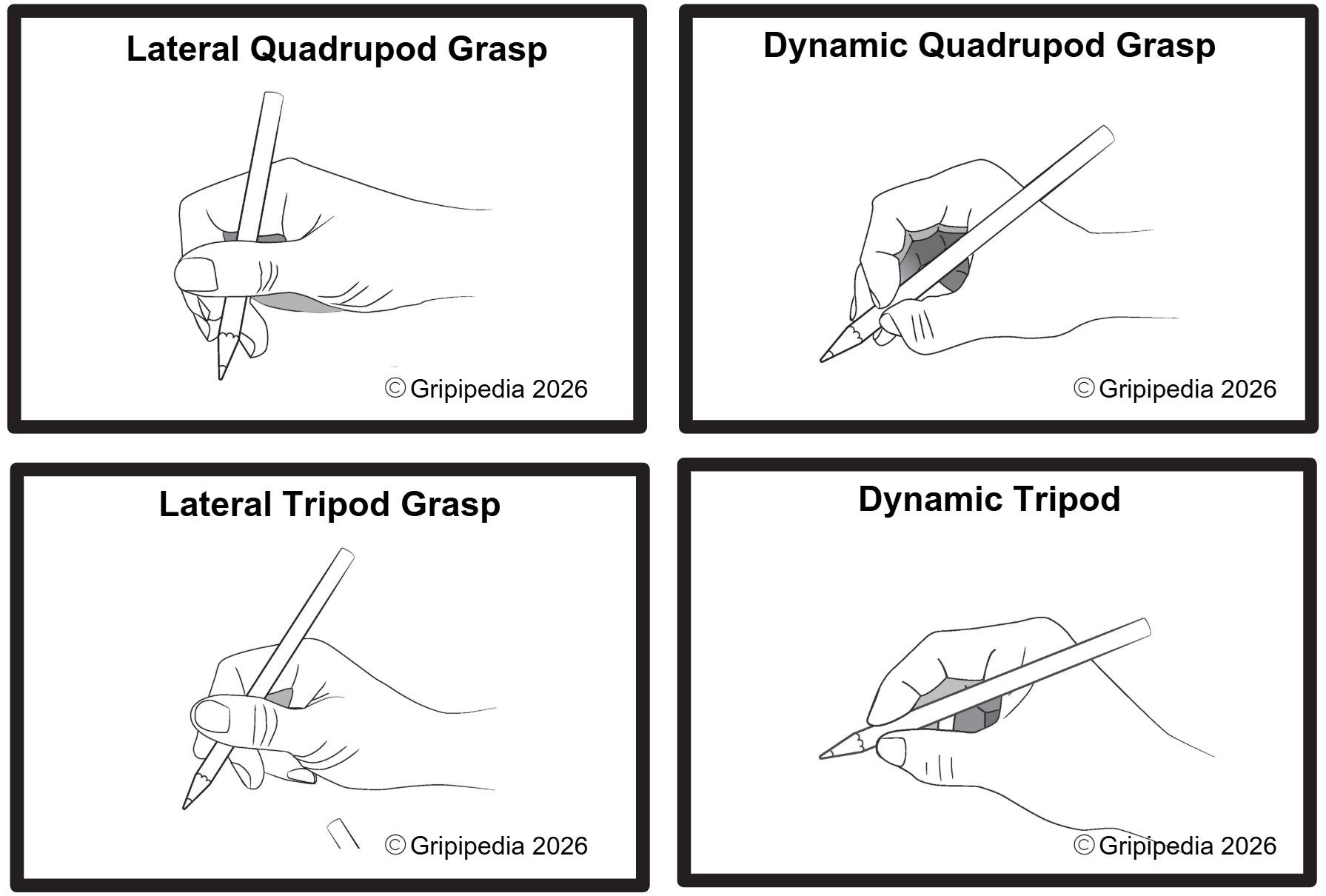
All Four Mature Patterns: Equally Functional!
- Dynamic Tripod: The classic three-finger grasp everyone recognizes
- Lateral Tripod: Three fingers with thumb crossing over – still dynamic and efficient
- Dynamic Quadrupod: Four fingers with movement from finger joints, not the wrist
- Lateral Quadrupod: Four fingers with thumb crossing over but maintaining finger mobility
(Gripipedia, © 2026; Donica et al., 2013)
Just this week, I evaluated a second-grader referred for “poor grasp” who was using a lateral quadrupod. Her handwriting was gorgeous, she could write for 10 minutes without fatigue, and her letters were beautifully formed. The only “problem” was that her grasp didn’t match the classroom poster! We celebrated her functional pattern and educated the team about research-backed mature grasps. Knowledge changes everything.
What Really Matters in Development
After seeing hundreds of children progress through these stages, I’ve learned that development is beautifully individual. Some kids show mature patterns by age 4, others develop them closer to 7 or 8. Hand size, joint mobility, muscle tone, sensory preferences, and even personality influence this timing.
Function Over Form Always
A grip that allows comfortable, efficient writing beats a “perfect-looking” grip that causes fatigue every single time. I’ve seen children with textbook tripods who complain of pain after 5 minutes, and kids with lateral patterns who can write novels without tiring.
Endurance Tells the Story
Can the child sustain their grip for age-appropriate writing tasks without pain or excessive fatigue? That’s your real measure of functional success, not what the grip looks like in a snapshot.
Dynamic Movement is Key
Whether it’s tripod or quadrupod, lateral or traditional, the magic happens when fingers can move independently while the ring finger and pinky provide stability. That’s what makes writing efficient and sustainable.
When to Actually Be Concerned:
-
Consistent complaints of hand or finger pain during writing activities
-
Complete avoidance of fine motor tasks that peers enjoy
-
Significant fatigue after age-appropriate amounts of writing
-
Grip patterns that consistently interfere with letter legibility
-
No progression in grip development over 6-12 months with regular exposure
-
Regression to earlier patterns after mastering more mature ones
Supporting the Natural Progression
Understanding this visual progression changes how we support children’s development. Instead of forcing specific grip patterns, we can build the foundational skills that allow natural progression to unfold.
Build the Foundation
Core strength creates shoulder stability, which enables elbow control, which allows wrist stability, which provides the platform for finger dexterity. You cannot skip steps in this kinetic chain!
Honor Each Stage
Those transitional patterns aren’t problems to fix – they’re important developmental stepping stones. Rushing past them often creates compensatory patterns that show up later as endurance or pain issues.
Consider Individual Differences
Some children have longer fingers that naturally accommodate quadrupod patterns. Others have hypermobile joints that benefit from lateral thumb positioning. Work with each child’s unique structure, not against it.
Want This Complete Visual Reference? 📚
This developmental progression chart is just one tool from my comprehensive Gripipedia resource collection. Having clear visual references transforms how you understand and explain pencil grip development to parents, teachers, and colleagues.
My upcoming book includes this complete visual progression plus detailed intervention strategies, troubleshooting guides, and evidence-based approaches for supporting each developmental stage.
You’ll never again wonder if what you’re seeing is normal variation or a pattern that needs support. The visual clarity makes all the difference in confident clinical decision-making!
Ready to have the visual tools that make you the go-to expert for pencil grip guidance? Join my email list for early access to these comprehensive resources!
References
Donica, D. K., Goins, A., & Wagner, L. (2013). Effectiveness of handwriting readiness programs on postural control, hand control, and letter and number formation in Head Start classrooms. Journal of Occupational Therapy, Schools, & Early Intervention, 6(2), 81–93.
Gripipedia. (© 2026). Developmental progression of pencil grasp—right hand [Developmental progression chart]. Gripipedia Publications.
Schneck, C. M., & Henderson, A. (1990). Descriptive analysis of the developmental progression of grip position for pencil and crayon control in nondysfunctional children. American Journal of Occupational Therapy, 44(10), 893-900.
Schwellnus, H., Carnahan, H., Kushki, A., Polatajko, H., Missiuna, C., & Chau, T. (2012). Effect of pencil grasp on the speed and legibility of handwriting after a 10-minute copy task in Grade 4 children. Australian Occupational Therapy Journal, 59(3), 180-187.