
The Truth About Pencil Grip Research That Every OTP, Teacher, and Parent Needs to Know
I cannot tell you how many times I’ve heard it in IEP meetings, teacher lounges, and even OT conferences: “Well, research shows that grasp doesn’t really matter for handwriting.” 😤
Every time I hear this, my heart sinks a little. Because here’s the thing – that statement isn’t wrong, but it’s dangerously incomplete. And it’s leaving struggling kids without the support they desperately need.
The Real Problem
When people say “grasp doesn’t matter,” they’re referencing studies that only looked at children with mature, functional grasp patterns. They completely excluded kids with immature or dysfunctional grasps from their research!
What the Research Actually Shows
Let me break down what multiple studies from 1993-2018 have actually discovered, because the full picture tells a completely different story.
Research Reality Check
Studies by Donica et al. (2018), Schwellnus et al. (2012, 2013), and Koziatek & Powell (2003) consistently show that mature grasp patterns perform equally well. But here’s the catch – they only studied mature grasps.
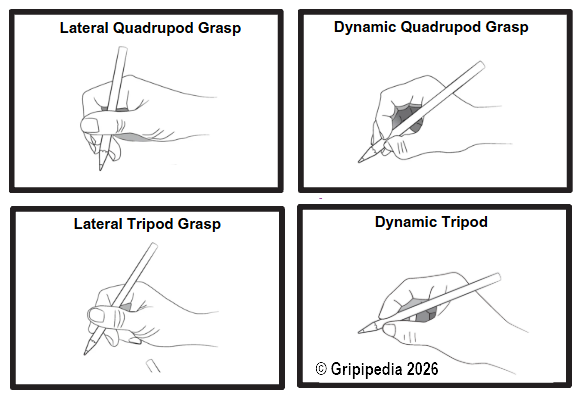
The Four Functional Grasps ✅
Current research recognizes these four grasp patterns as equally mature and functional:
-
Dynamic Tripod – The “classic” three-finger grasp
-
Dynamic Quadrupod – Four fingers with dynamic movement
-
Lateral Tripod – Three fingers with thumb crossing over
-
Lateral Quadrupod – Four fingers with thumb crossing over
(Donica et al., 2018; Schwellnus et al., 2012)
So yes, if your child uses any of these four patterns, grasp truly doesn’t impact their handwriting speed or legibility. The dynamic tripod isn’t the “gold standard” anymore – it’s just one of four equally good options!
But Here’s Where Grasp ABSOLUTELY Matters
The Missing Piece: Studies consistently show that immature or static pencil grasps lead to increased fatigue and decreased legibility (Almeida et al., 2013; Dennis & Swinth, 2001; Schwellnus et al., 2012).
I see this every single day in my practice. The second-grader whose hand cramps after writing three sentences. The kindergartener who holds their pencil in a fisted grip and can barely form recognizable letters. The fourth-grader who avoids writing assignments because “it hurts.”
In Schwellnus et al.’s 2012 study of 120 students, guess what happened to the three children with immature grasp patterns? They were classified as “dysgraphic writers.” Every. Single. One.
Clinical Reality
When children use immature grasps, they’re recruiting the large muscles of their forearm and wrist to move the pencil instead of the small, precise muscles in their hand. This leads to fatigue, pain, and poor letter formation.
The Problem with the Research
Here’s why that “grasp doesn’t matter” statement is so misleading. Most studies have significant limitations:
-
Exclusion bias: They excluded children with immature or “atypical” grasps
-
Sample size: Many studies had very small samples (i.e., 46 children) with only 1-3 children using atypical grasps
-
Writing duration: Most only analyzed 1-4 sentences, not real classroom demands
-
Limited scope: They omitted children receiving OT services
(Donica et al., 2018; Schwellnus et al., 2013)
The Hidden Cost: Missing Out on Daily Fine Motor Strengthening
Here’s something that keeps me up at night as an OT; and it’s something most people never consider when they dismiss grasp concerns.
Think about a typical school day for a moment. Kids use pencils during morning work, math worksheets, spelling practice, journal writing, note-taking, homework, art projects, and about a dozen other activities. We’re talking about hours of pencil use every single day! 📝
The Missed Opportunity
When children use mature, functional grasps, every single one of those writing moments becomes a fine motor strengthening session. Their small hand muscles get stronger, more coordinated, and more precise with each word they write.
But here’s what breaks my heart: when kids use immature or compensatory grasps, they’re essentially doing bicep curls when they should be doing finger exercises. Instead of strengthening the small, intricate muscles needed for button fastening, shoelace tying, and precise manipulation, they’re reinforcing inefficient movement patterns hour after hour, day after day.
I had one third-grader whose teacher said, “He writes so much better in the morning, but by afternoon, his letters fall apart.” That’s not a motivation problem – that’s a child whose forearm muscles are exhausted from doing a job they were never meant to do!
Clinical Insight
Every writing task could be building the foundation for independence with dressing, eating, and play skills. When we ignore inefficient grasps, we’re not just missing handwriting goals – we’re missing opportunities for comprehensive fine motor development.
The research on grasp strength and functional independence backs this up beautifully. Alaniz et al. (2015) found that grasp strength correlates directly with pencil control AND independence with daily activities. When children develop strong, coordinated hand muscles through proper pencil use, those benefits extend far beyond the classroom.
What This Means for Your Practice
Stop feeling guilty about addressing grasp patterns! 🌟 If a child is struggling with handwriting endurance, complaining of pain, or showing decreased legibility over time, their grasp absolutely could be the culprit.
The research supports us when we say: Functional grasp matters. Mature patterns matter. And children with immature patterns may deserve our intervention.
Want to Dive Deeper? 📚
This blog post barely scratches the surface of what current research tells us about pencil grasp, fine motor development, and handwriting outcomes.
I’ve spent years analyzing the research, working with hundreds of children, and developing evidence-based strategies that actually work.
My upcoming book breaks down all the latest research in practical, actionable ways that will transform how you think about pencil grip intervention. Want to be the first to know when it’s available?
Join my email list for research updates, clinical insights, and early access to evidence-based resources that will change your practice!
References
Alaniz, M. L., Galit, E., Necesito, C. I., & Rosario, E. R. (2015). Hand strength, handwriting, and functional skills in children with autism. American Journal of Occupational Therapy, 69(4), 6904220030.
Almeida, G. L., Marconi, N. F., Tortoza, C., Ferreira, S. S., Filho, J. E., & Navarro, F. M. (2013). Comparison of perceptual-motor and visual-motor skills between Down syndrome and typical children. Research in Developmental Disabilities, 34(7), 2182-2188.
Dennis, J. L., & Swinth, Y. (2001). Pencil grasp and children’s handwriting legibility during different-length writing tasks. American Journal of Occupational Therapy, 55(2), 175-183.
Donica, D. K., Goins, A., & Wagner, L. (2018). Effectiveness of handwriting readiness programs on printing performance in kindergarten students. Journal of Occupational Therapy, Schools, & Early Intervention, 11(4), 484-496.
Koziatek, S. M., & Powell, N. J. (2003). Pencil grips, legibility, and speed of fourth-graders’ writing in cursive. American Journal of Occupational Therapy, 57(3), 284-288.
Schwellnus, H., Carnahan, H., Kushki, A., Polatajko, H., Missiuna, C., & Chau, T. (2012). Effect of pencil grasp on the speed and legibility of handwriting after a 10-minute copy task in Grade 4 children. Australian Occupational Therapy Journal, 59(3), 180-187.
Schwellnus, H., Carnahan, H., Kushki, A., Polatajko, H., Missiuna, C., & Chau, T. (2013). Effect of pencil grasp on the speed and legibility of handwriting in children. American Journal of Occupational Therapy, 67(6), 718-717.
Wallen, M., Duff, S., Goyen, T.-A., & Froude, E. (2013). Respecting the evidence: Responsible assessment and effective intervention for children with handwriting difficulties. Australian Occupational Therapy Journal, 60(5), 366–369. https://doi.org/10.1111/1440-1630.12045