
🎥 Free Live Webinar: Discover How Children Grip & Grasp
Thu, Oct 1, 2026 · 7:00 PM EDT · Book Launch Live!
Save My Seat →Last year, I got a panicked email from a second-grade teacher: “I have a student whose pencil grasp looks perfect, just like the poster in my classroom, but she’s complaining of hand pain after just five minutes of writing. What am I missing?”
This happens more often than you might think. Parents and teachers see a grasp that looks “right” and assume everything is fine; meanwhile a child is developing compensatory patterns that will cause problems down the road. Sometimes the most concerning grasp issues are the ones that hide in plain sight.
After 20+ years of clinical practice, I’ve learned that the children who worry me most aren’t always the ones with obviously “wrong” grasps. They’re the ones whose dysfunction is subtle, whose pain develops gradually, and whose struggles get dismissed because their pencil hold “looks fine” to untrained eyes and their handwriting is legible.
That’s why I’m sharing the clinical assessment skills that help me spot trouble before it becomes a crisis. These are the warning signs that most people miss, but you won’t, once you know what to look for.
The Secret Behind Hidden Dysfunction
Just because a pencil grasp looks “funny” doesn’t mean it’s dysfunctional. The opposite is also true. A child may demonstrate an “atypical grasp”, but if it’s functional, it works! The key is spotting a potential problem before it gets “locked in”.
Grasp patterns that look “acceptable” may still cause significant problems. Studies indicate that immature pencil grasp patterns lead to increased fatigue and poor handwriting legibility (Almeida et al., 2013; Dennis & Swinth, 2001; Koziatek & Powell, 2003; Schwellnus et al., 2012).
In a study of 120 students, Schwellnus et al. (2012) found that the three students with immature grasp patterns were classified as “dysgraphic writers.” Even more concerning, Tseng and Cermak (1993) reported that “writing with too much pressure on the pencil, regardless of grasp pattern, can cause greater muscle fatigue.”
Here’s what’s happening beneath the surface: in a mature pencil grasp, the small muscles of the hand control the pencil with precision and efficiency. But in an immature or static grasp, the large muscles of the forearm and wrist do all the work. It’s like using a sledgehammer to hang a picture frame; technically it works, but it’s exhausting and imprecise.
Inefficient grasps often develop as compensations for instability in joints and muscle strength. Children unconsciously adapt their grasp to work around underlying weaknesses, creating patterns that might function short-term but cause problems as writing demands increase.
The Warning Signs Everyone Misses
Teachers often refer children to me with reports like, “He complains that it hurts” and “She refuses to write more than a few sentences.” By the time these obvious red flags appear, dysfunction has been building for years. The key is catching the subtle signs before they become obvious problems.
Red Flags That Hide in Plain Sight
- The “Perfect” Grasp with Pain: Fingers positioned correctly, but the child complains of discomfort or rushes through writing tasks
- Pressure Extremes: Writing so light it’s barely visible or so dark it tears paper
- Speed That Plummets: Starts assignments quickly but slows dramatically within minutes
- The Grasp Switcher: Changes hand position multiple times during single activities
- Whole-Body Writers: Shoulder and neck tension while writing, even with “good” finger position
- The Avoidance Artists: Suddenly has to use the bathroom, complains of stomachaches during writing time
I’ll never forget Emma, a first-grader whose teacher insisted her grasp was “textbook perfect.” When I observed Emma during a writing assignment, her tripod grasp looked flawless from across the room. But up close, I noticed her thumb was hyperextended, her index finger was doing all the work, and her middle finger was just along for the ride. She was essentially writing with a two-finger grasp disguised as a tripod. After ten minutes, her hand was cramping and her letters were getting wobbly.
What “Good” Grasps Look Like When They’re Actually Problematic
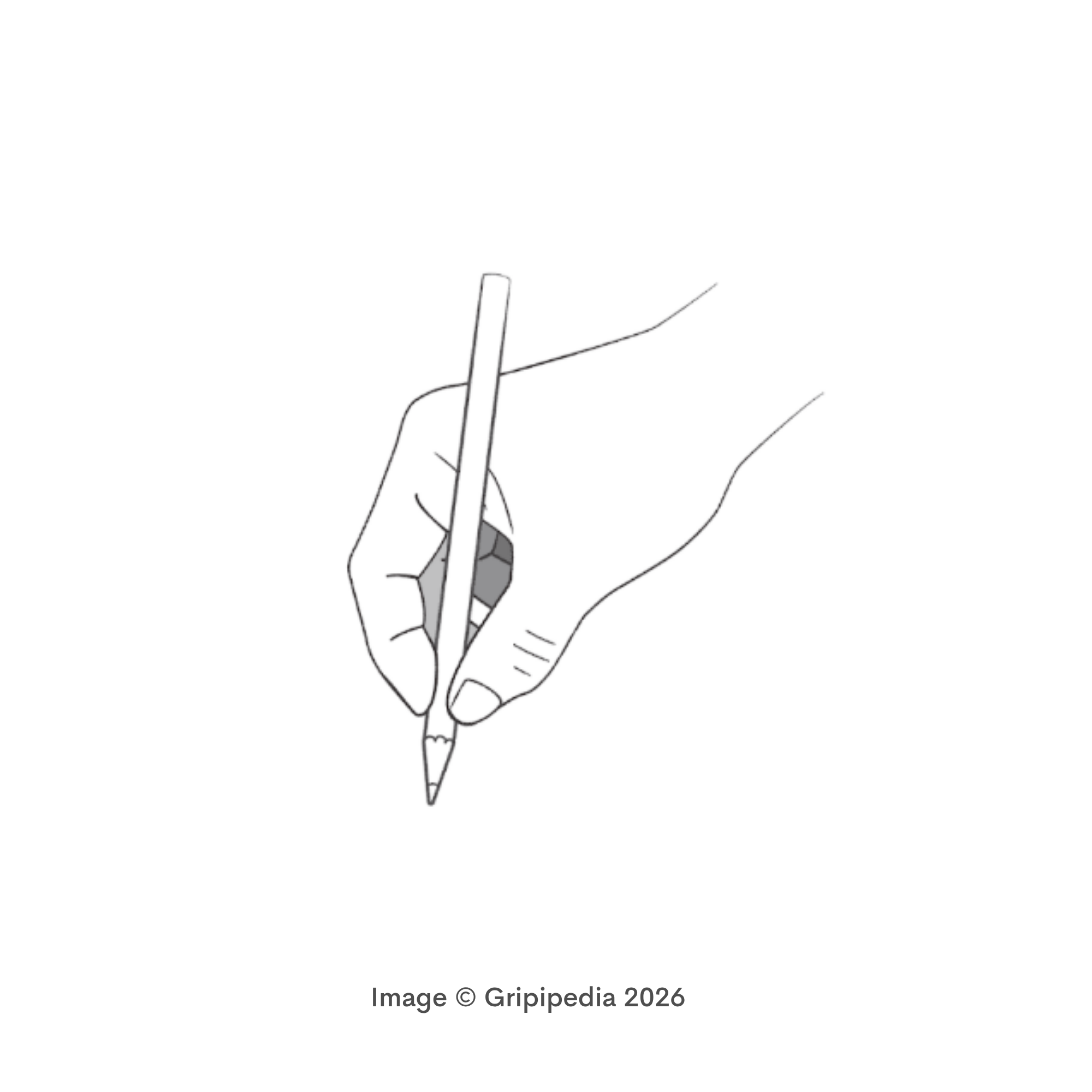
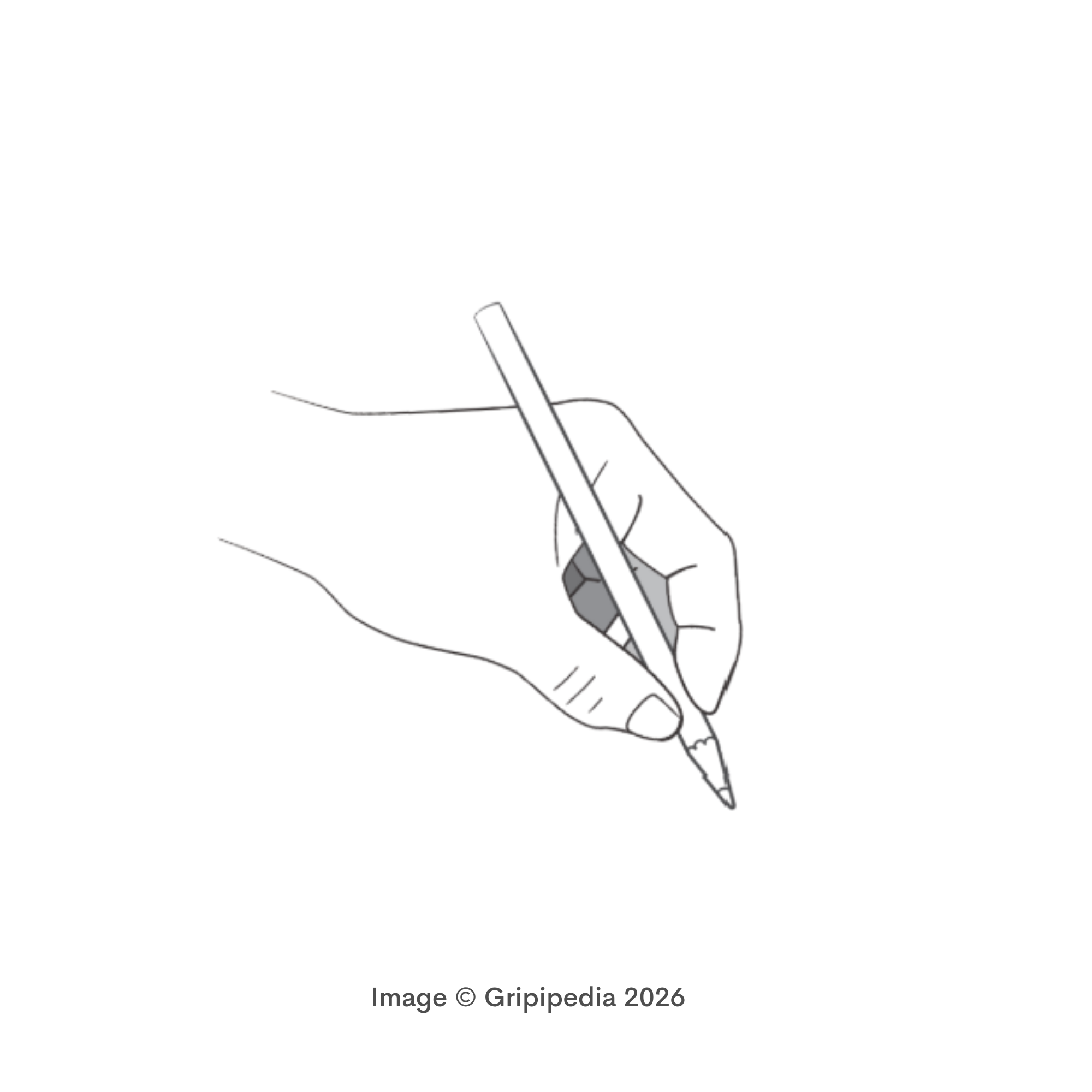
This is probably the most commonly misidentified grasp issue. The fingers are positioned correctly – thumb, index, and middle finger on the pencil – but they move as one rigid unit instead of working independently. This is called a static grasp. The wrist is in slight extension. Children using this pattern often develop hand fatigue quickly because they’re using way more muscle than necessary.
Keep in mind, a static tripod is age-appropriate for kids who are between 3.6 and 4.5 years old. It’s when older kids (who have much more expected of them) are still using it that it becomes a problem.
What to look for: The pencil moves by wrist or shoulder motion rather than finger motion. The grasp looks right in a snapshot but lacks the fluid finger movements needed for efficient writing. A “floating” wrist or forearm also indicates that the child probably isn’t using finger movements.
The Muscle Recruitment Pattern
Observing where the movement originates can tells me immediately whether a child is using mature or compensatory patterns, even when the grasp looks acceptable.
Try this: Watch where the movement comes from when the child writes. Is the pencil control coming from:
- ✓ Finger movement: showing isolated movements after 4.5 years
- ⚠ Wrist motion: Compensatory pattern, will fatigue quickly
- ⚠ Elbow movement: Inefficient
- ⚠ Shoulder movement: Very immature pattern, unsustainable
Children who move their pencils with their shoulders or wrists are essentially doing the motor equivalent of running a marathon while carrying a backpack. They’ll get where they’re going, but they’ll be exhausted when they arrive.
The Developmental Foundation Problem
Alaniz et al. (2015) revealed that grip strength correlates with handwriting legibility in typically developing children and with pencil control as well as independence with functional activities. Children need precise control over hands and fingers to manipulate a writing utensil, utensils, toys, and clothing fasteners.
Fine motor skill development follows a predictable pattern – from the center of the body outward. Children develop control of their whole arm, then their hand, and finally their fingers. When we rush this process or skip foundational steps, we see compensatory grasps that look functional but create problems later.
The Early Warning System
Children’s in-hand manipulation skills and fine motor control may impact handwriting legibility, as well as ADL skills, and their ability to play with toys. But you don’t need fancy assessments to spot trouble brewing.
Simple Screening Questions:
- Does the child avoid writing activities that peers enjoy?
- Do they complain of tiredness or pain during age-appropriate writing tasks?
- Does their writing quality deteriorate significantly over the course of an assignment?
- Do they press extremely hard or extremely light with writing tools?
- Do they frequently switch hands or adjust their grasp during writing?
If you answered yes to any of these, it’s worth investigating further, even if the grasp “looks fine.”
Grasp patterns are often the visible symptom of invisible problems. Weakness in core stability, shoulder control, or sensory processing can all accompany grasp dysfunction.
When to Trust Your Instincts
If a child is complaining of pain, avoiding writing, or showing declining performance over time, something isn’t working – regardless of how their grasp looks. Trust functional performance over appearance every single time.
If functional performance is age-appropriate, and the child isn’t complaining, let it go.
When to Seek Professional Help
- Persistent complaints of hand, wrist, or arm pain during writing
- Significant avoidance of age-appropriate writing tasks
- Declining handwriting quality over the course of assignments
- Grasp patterns that interfere with letter formation or legibility
- Excessive fatigue during writing tasks that peers handle easily
- Multiple grasp changes or compensatory strategies during single tasks
Efficient writing should not be painful or exhausting for children. When it is, there’s always a reason – and there’s usually a solution.
Want to Develop Your Assessment Eye? 📚
Learning to spot hidden dysfunction requires understanding the complex relationship between grasp patterns, motor development, and functional performance. It’s not about memorizing red flags – it’s about understanding the developmental foundations that create truly functional writing skills.
My upcoming Gripipedia book includes decision charts, visual guides for identifying dysfunction, and systematic approaches for addressing the underlying issues that create compensatory grasp patterns.
You’ll learn to see beyond surface-level grasp appearances to the fundamental motor patterns that either support or sabotage long-term fine motor success.
Ready to become the person who spots problems before they become crises? Join my email list for early access to these comprehensive assessment tools!
References
Alaniz, M. L., Galit, E., Necesito, C. I., & Rosario, E. R. (2015). Hand strength, handwriting, and functional skills in children with autism. American Journal of Occupational Therapy, 69(4), 6904220030.
de Almeida, P. H. T. Q., da Cruz, D. M. C., Magna, L. A., & Ferrigno, I. S. V. (2013). An electromyographic analysis of two handwriting grasp patterns. Journal of Electromyography and Kinesiology, 23(4), 838–843. https://doi.org/10.1016/j.jelekin.2013.04.004
Brown, T., & Link, J. (2016). The relationship between handwriting speed and legibility in children. Australian Occupational Therapy Journal, 63(4), 259-267.
Cornhill, H., & Case-Smith, J. (1996). Factors that relate to good and poor handwriting. American Journal of Occupational Therapy, 50(9), 732-739.
Dennis, J. L., & Swinth, Y. (2001). Pencil grasp and children’s handwriting legibility during different-length writing tasks. American Journal of Occupational Therapy, 55(2), 175-183.
Koziatek, S. M., & Powell, N. J. (2003). Pencil grips, legibility, and speed of fourth-graders’ writing in cursive. American Journal of Occupational Therapy, 57(3), 284-288.
Schwellnus, H., Carnahan, H., Kushki, A., Polatajko, H., Missiuna, C., & Chau, T. (2012). Effect of pencil grasp on the speed and legibility of handwriting after a 10-minute copy task in Grade 4 children. Australian Occupational Therapy Journal, 59(3), 180-187.
Tseng, M. H., & Cermak, S. A. (1993). The influence of ergonomic factors and perceptual-motor abilities on handwriting performance. American Journal of Occupational Therapy, 47(10), 919-926.