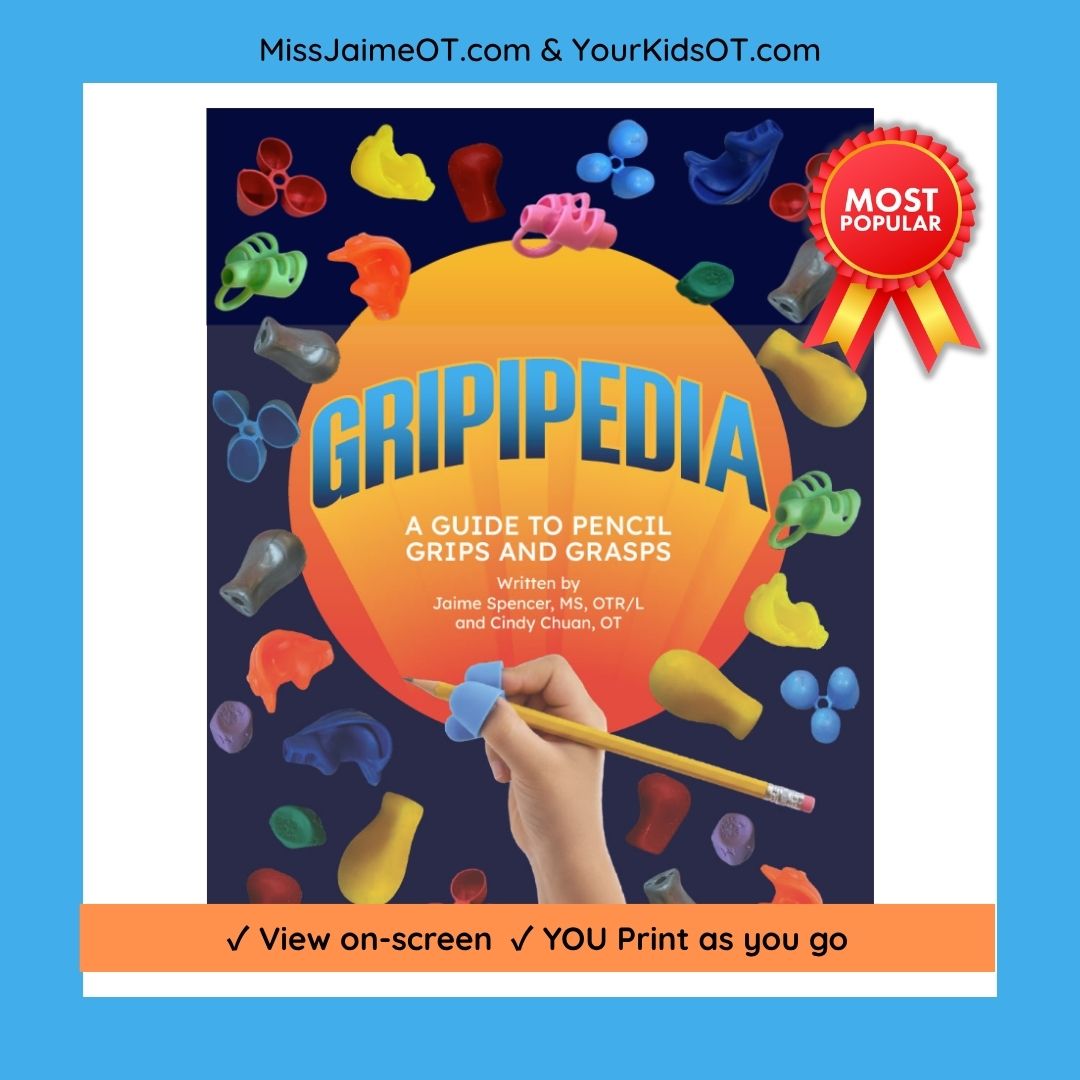
Gripipedia: A Guide to Pencil Grips and Grasps
The guide you always wanted, from two pediatric OTs who spent nine years figuring this out so you don’t have to.
151 pages. The first half is research and clinical decision-making. The second half is 42 printable resource pages you’ll use every week.
GET THE DIGITAL EDITION: $29 Launch Value Price
Retail cost after 11/1/2026 will be $39 · Instant download
Prefer a coil-bound print copy? See the print edition →
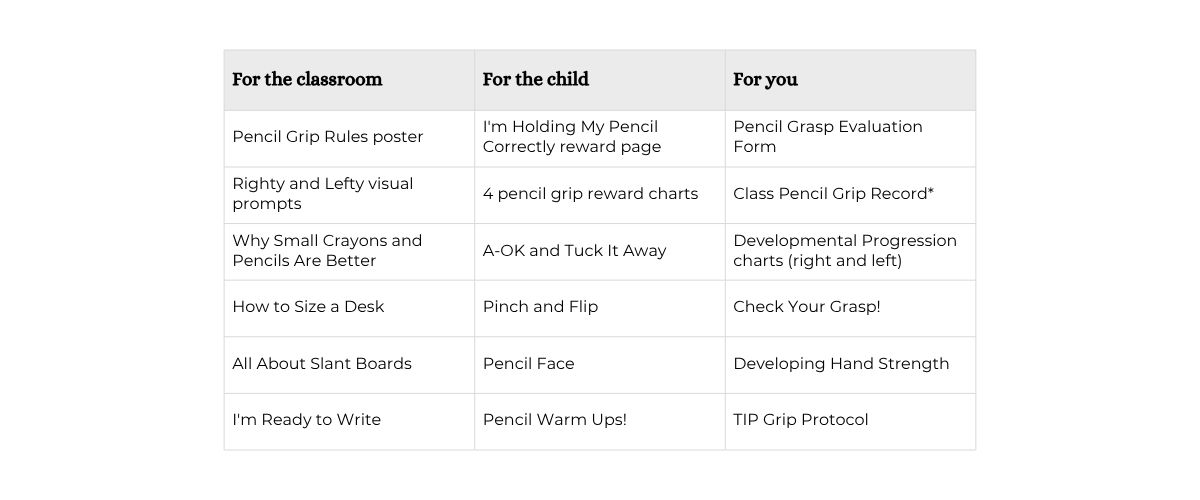
*The Class Pencil Grip Record is the one people don’t expect to love. It’s a single sheet with every grip pictured, so a teacher can check off which student has which one. No more “the blue squishy one, I think?” Hand it to the classroom teacher in September, and you’ll both know where things stand in June.
Who it’s for
- School-based OTs and COTAs who want the research nailed down and the handouts already made
- Clinic-based pediatric OTs who need parents to follow through between sessions
- Teachers and special educators who’ve been told grasp matters but never told what to look for
- OT students and new grads who want one book instead of nine tabs and a Facebook group
- Anyone leading a district handwriting or MTSS initiative
If you supervise or mentor, this is also what you hand a new therapist so you don’t have to explain grip selection from scratch every fall.
Why we wrote it this way
Handwriting instruction has been squeezed out of the school day while expectations have gone up. Kids are handed pencils at three and four, before their hands are ready. The grasp habits they build to compensate get locked in early, often by the end of kindergarten in what we’ve both observed.
We think readiness skills belong back in the conversation. The fastest way to get there isn’t another article. It’s putting a good handout in the hands of the adult who’s with that child all day.
We did the research. We wrote the handouts. You get your Sunday night back.
Formats and pricing
⭐ Digital Edition (PDF): Most popular
$49 $39 USD for a limited time
- The complete 151-page book, delivered in 10 days
- Read it on any screen, and search it when a question comes up mid-session
- Print the resource pages as many times as you want on your school copier, for the length of your career
This is the format most people choose, and it’s the one we recommend.
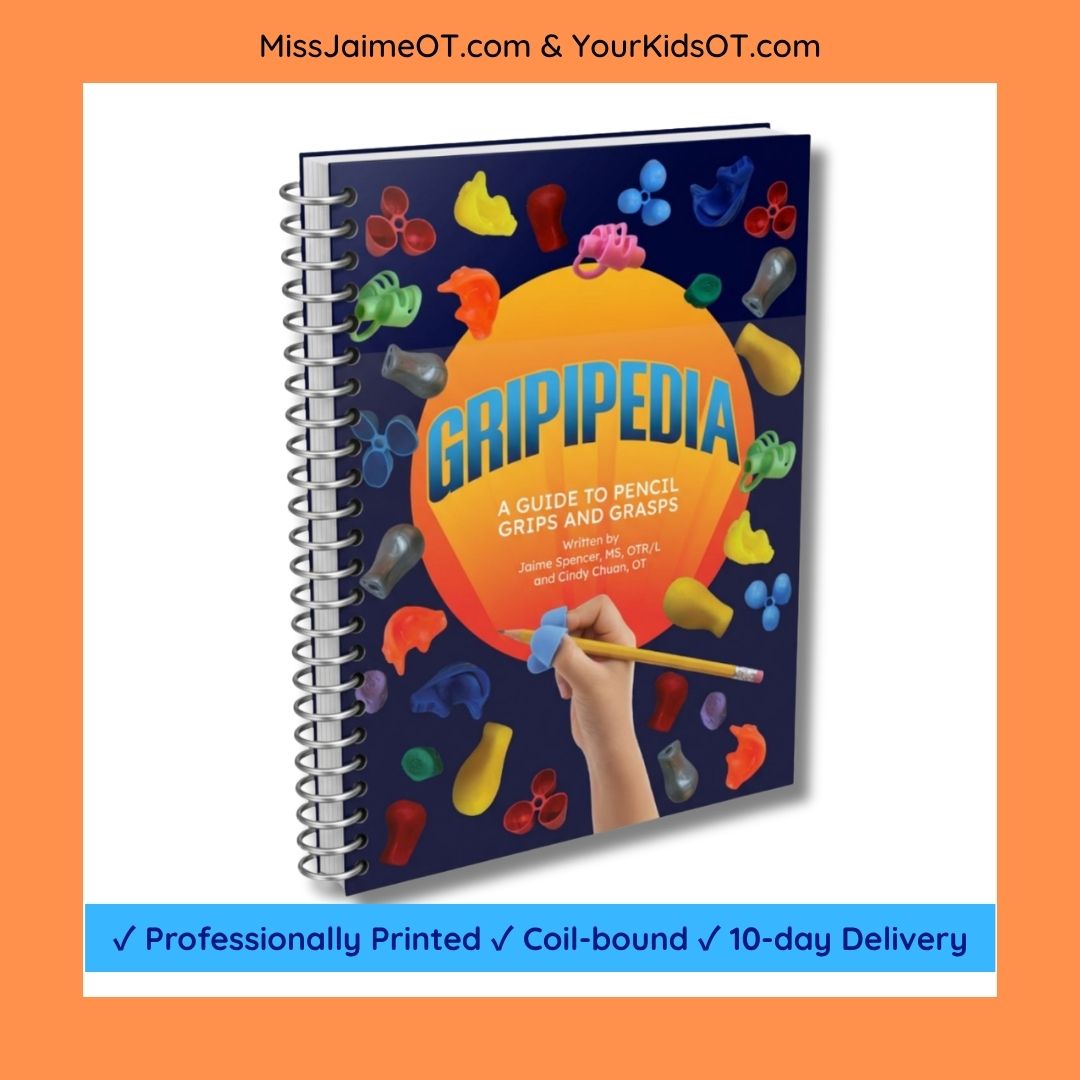
Print Edition (Coil-Bound) + Digital
$69 $59 USD for a limited time
- A full-color, spiral-bound copy that lays flat on a copier
- Includes the complete digital edition at no extra cost
- Ships within up to 10 business days
An honest note about print: we chose premium color so the grip photos are usable, and printing at that quality costs what it costs. The print edition is priced to cover that cost, not to make money. If budget matters, get the digital edition. It’s the same book, and you can print the pages you need.
Original price was: $39.00.$29.00Current price is: $29.00.
Original price was: $79.00.$49.00Current price is: $49.00.
Purchasing for a district or a department? Contact us about bulk copies. Help@MissJaimeOT.com
About the authors

Jaime Spencer, MS, OTR/L
MissJaimeOT.com, New York, United States
Jaime. from Miss Jaime. OT, has a Bachelor’s degree in occupational therapy from Utica College and a Master’s Degree in Special Education from Adelphi University. Miss Jaime. O.T., P.C. is an approved provider of continuing education from the American Occupational Therapy Association. She has been a Long Island pediatric OT for twenty-five years and currently works in a public school setting with students Kindergarten to 12th grade. Jaime is a passionate advocate for occupational therapists. speaking nationally on the topic of parity for school-based practitioners. She is the administrator of the grassroots advocacy coalition “USA School-based OTPs Looking for Change”.
Cindy Chuan, OT
YourKidsOT.com, Sydney, Australia
Cindy, from Your Kids OT, has a Bachelor’s Degree in Applied Science (occupational therapy) from the University of Sydney. Cindy has worked as an occupational therapist in both the public sector (disability and community health) and private sectors over for 26 years. She now runs her own private practice in Sydney, Australia. Cindy loves finding ways to make learning fun and encouraging a child’s development in their natural environments.
Cindy is passionate about supporting and training occupational therapists with knowledge translation.
She also enjoys her own occupations of walking her dog, playing board games with her own children, crocheting and reading.
Nine years, two hemispheres, a lot of 4:20 a.m. video calls, and a truly unreasonable number of photographs of their own children’s hands.
Illustrations by Waed Haddad. Design by Francis Loh. With thanks to Jan McClesky for the TIP Grip Protocol.
You already know how this goes.
You find a grip that finally works for a kid. You show them how to use it. They nail it in your session.
Then Thursday comes. The grip is in the bottom of a desk, the child is back to a thumb wrap, and the teacher didn’t notice, because nobody ever told her what to look for.
Meanwhile, you’re keeping track of eleven students with six different grips in your head, because there’s no good place to write it down.
If that sounds familiar, this book was built for you.
What we made, and why
Jaime and Cindy have both been doing this a long time, on two different continents. We kept running into the same headaches:
- Helping a stubborn child change a grasp pattern they’ve had since preschool
- Getting a teacher to pay attention to grasp in the first place
- Getting carryover into the classroom when you’re only there once a week
- Convincing parents to follow through at home
- Keeping track of which kid has which grip
- Teaching parents and teachers to pick a grip without a 40-minute in-service
- Motivating a child to use their grip correctly when you’re not standing there
Picking the right grip is tricky. Getting it used consistently and correctly is the hard part. So we wrote the book around both problems.
The first half teaches you the why. The second half is what you hand to everybody else.
The first half: clinical content
This is the part that makes you the person in the building who knows what they’re talking about. It has fifteen chapters across four sections.
Section 1: Pencil Grasp Fundamentals
- What the research says. There are four equally mature, functional grasps, not one. The dynamic tripod stopped being the gold standard a while ago.
- The “grasp doesn’t affect legibility” problem. Most of those studies only included children who already had mature grasps. We walk through the samples and their limitations, so you can answer that comment in a meeting with something better than a feeling.
- Efficient grasp within MTSS, with a full Tier 1, 2, and 3 framework. If you’re working your way into general ed under ESSA, this chapter is your argument.
- Development of pencil grasp, with photographs, plus hand anatomy, joint laxity and adaptive grasps, and the fine motor skills underneath grasp, with activities for each.
Section 2: Evaluation of Pencil Grasp
- A pencil grasp evaluation form, plus written description examples, so your reports say more than “immature grasp noted”
- The Gripipedia Pencil Grasp Decision Guide, which lays out step by step whether a grasp should be changed and what to do if it shouldn’t
- Shared definitions (functional, efficient, dynamic, static, tripod, quadrupod, lateral, adaptive), so you and the teacher are using the same words
- When to change an inefficient grasp, when to leave it alone and move to AT, and case studies
Section 3: Teaching Pencil Grasp
- Teaching by age, because a 3-year-old and a 9-year-old need different things
- Vertical surfaces and alternative positioning
- Finger positioning, cues, and the small-versus-jumbo crayon question (the research isn’t on jumbo’s side)
- Accommodation and remediation: adapted tripod, grips, splinting and casting, slant boards, the TIP Grip Protocol, and adaptive pencils
Section 4: Pencil Grasp and Handwriting
- Posture, positioning, and readiness
- Pencil pressure, with case studies
- Left-handed writers, with a full chapter instead of a footnote
Plus a parent-friendly FAQ. Is it ever too late? My writing is neat with the “wrong” grasp, so why bother? Are grips worth it if they keep getting lost? Is grasp hereditary? The answers are written so you can hand them over instead of explaining for the four hundredth time.
The second half: 42 resource pages
This is the part we’re proudest of, and it doesn’t exist anywhere else.
Every page is designed to be printed and copied for as long as you practice. Permission is granted right in the book to copy them for your students, their families, and your colleagues. Just keep the Gripipedia name on them.
18 “Let’s Try a Pencil Grip” one-pagers
Each one-pager covers one grip or tool. It shows the actual product and gives finger-by-finger positioning for righties and lefties. It includes a plain-language “why grasp matters” and “how you can help” section for the adult, spaces for the student’s name and your contact info, and a built-in reward chart.
Stetro · Grotto · Crossover · Pinch · The Pencil Grip · Jumbo · Writing C.L.A.W. · Egg · Butterfly · Ring · Monkey Tail · Pointer · Triangle · TIP Grip Protocol · Twist & Write · Handiwriter · Weighted Pencil · Handwriting Glove
Send one home. Tape one to a desk. Give one to a sub. Done.
And the rest of it
Learn more about Grips & Grasps from these posts
Ready to stop reinventing the handout?
GET THE DIGITAL EDITION: $39
Instant download · Print the resource pages as often as you need
Not ready yet? Start with a free chart.
Free Pencil Grasp Developmental Progression Chart
First Name · Email Address · [Send me the chart]
We respect you and your inbox. Unsubscribe anytime.