
Why Kids Cram Their Words Together (And What Actually Fixes It)
If you’ve ever looked at a first grader’s writing sample and thought is this one word or seven, you’re not alone. Spacing errors are one of the most common handwriting complaints I hear from teachers — and honestly, one of the easiest to address once you understand what’s going wrong and why.
Let’s break it down.
What’s Actually Happening When Kids Don’t Space
Spacing in handwriting isn’t just about aesthetics. It requires a child to hold a mental concept of “words as separate units” while simultaneously managing letter formation, pencil pressure, line placement, and ideation. That’s a lot of competing demands.
For young writers — we’re talking kindergarten through second grade — spacing errors usually fall into a few patterns:
- No spaces at all. Every letter runs directly into the next. The whole sentence is one long string.
- Inconsistent spaces. Some words have huge gaps, others are crammed together. No rhyme or reason.
- Letter spacing that looks like word spacing. The child puts equal space between every letter, so the words blend together visually.
The root causes vary. Some kids don’t have a strong enough concept of what a “word” is as a discrete unit. Others have the concept but lack the motor planning to consistently leave space as they move across the page. Some have spatial processing challenges. And some were just never explicitly taught — they picked up letter formation but nobody built in a system for spacing.
That last one? Totally fixable.
Enter the Spaghetti and Meatball Method
This is one of my favorite approaches to teach spacing because it gives kids a concrete, tactile metaphor that actually sticks — which is the whole point when you’re working with early learners.
Here’s the concept:
Spaces between letters are like a strand of spaghetti — thin, small, just a tiny gap.
Spaces between words are like a meatball — round, bigger, a noticeable chunk of space.
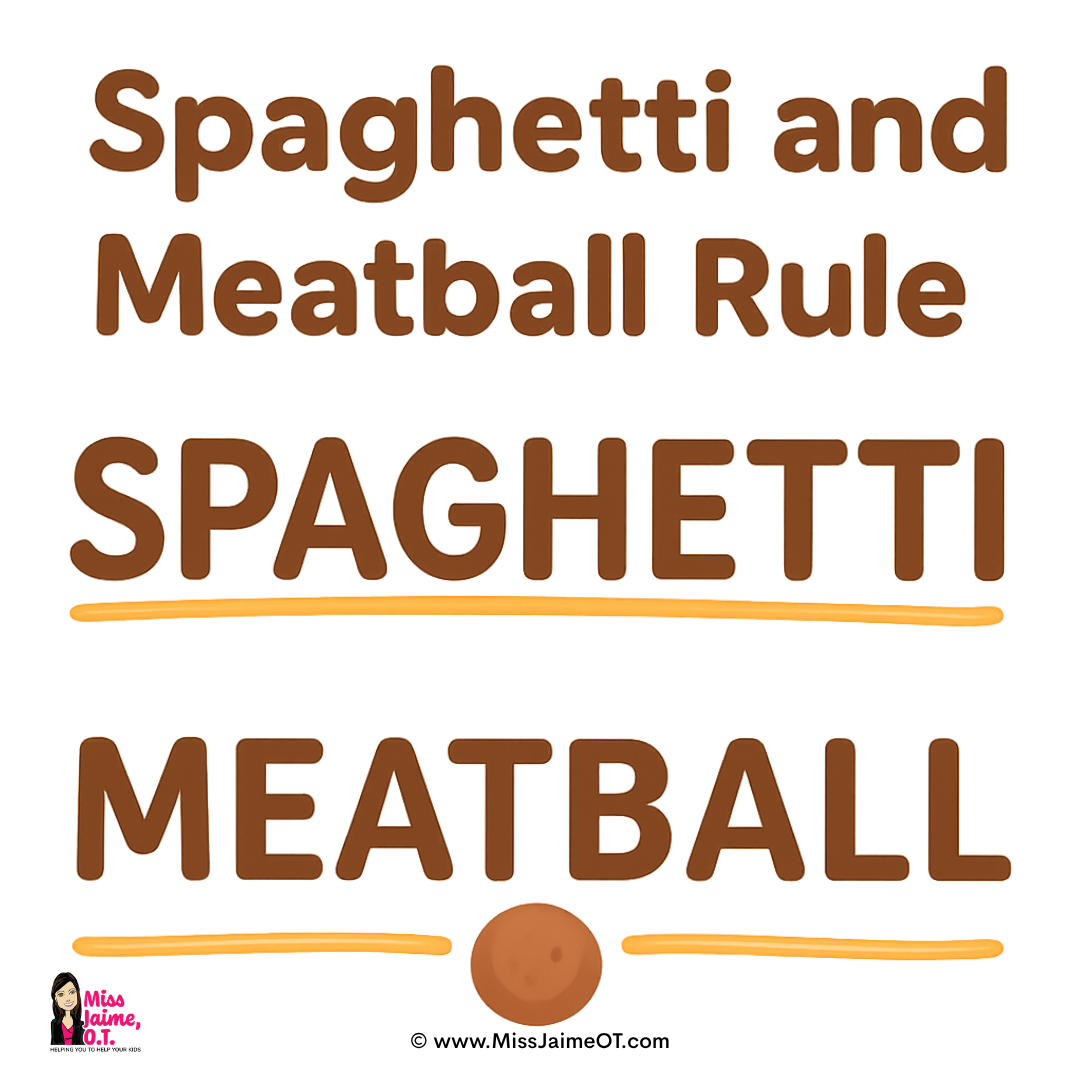
That’s it. Simple. But the visual is powerful because it maps directly onto what the writing should look like on the paper. Small wiggly gap between letters. Bigger rounder gap between words.
When you introduce it this way, kids can self-monitor in a way that abstract instruction (“remember to leave a space!”) never accomplishes. Instead of a vague reminder, they have a visual target: is there a meatball between my words?
How to Actually Implement It
Start with the concept before the pencil ever touches paper. Talk through it, show it, draw it on the board. Some teachers make a little chart: a picture of spaghetti (letter spacing) next to a picture of a meatball (word spacing). Laminate it. Put it on the desk. Reference it constantly.
Use finger spacing as a bridge. The traditional “finger space” strategy maps nicely onto the meatball concept — a finger is approximately a meatball’s worth of space. This works well for kids who need a proprioceptive cue alongside the visual one.
Try spacing tools for kids who need more support. Popsicle sticks, flat craft sticks, or small wooden blocks placed between words can make the space concrete and measurable. The child places the tool, writes the next word, removes the tool, repeats. It slows them down intentionally — which is the point.
Practice in isolation first. Don’t throw this at kids during a full writing assignment. Give them a short sentence, focus only on spacing, and let them succeed at something controlled before you ask them to manage everything at once.
Name it in your feedback. “I can see your meatballs between these words” lands better than “good spacing.” Specific feedback tied to the language you taught reinforces the concept and tells the child exactly what to keep doing.
When It’s More Than a Strategy Problem
Most kids respond well to explicit instruction and a concrete system. But if a child continues to struggle with spacing despite direct teaching, consistent practice, and appropriate modifications, that’s worth a closer look.
Persistent spacing difficulties — especially when paired with inconsistent letter sizing, poor line orientation, or difficulty with directionality — may signal underlying visual-perceptual challenges, motor planning difficulties, or a need for more comprehensive handwriting evaluation. That’s where OT assessment earns its place in the conversation.
Don’t just keep re-teaching the same strategy to a child who isn’t making progress. Do your evaluation, identify the root cause, and intervene accordingly.
The Bottom Line
Spacing errors are common, frustrating, and — in most cases — teachable. The spaghetti and meatball approach works because it gives kids a mental image that’s easy to recall, easy to self-check, and honestly, kind of hard to forget.
You’ve now got a tool that takes about two minutes to introduce and works across the classroom and in OT sessions. Use it, name it, and make it part of your handwriting vocabulary.
Thin like spaghetti between letters. Big like a meatball between words. Done.
??? There is nothing here about the spaghetti and meatball handwriting trick?